How Child Support Enforcement Works When Payments Stop
Learn how child support enforcement works after missed payments, including wage withholding, court hearings and steps either parent can take.
Child Support Estimate ·

When child support payments stop, the first step is usually to check the official payment record and contact the agency handling your case. An enforcement office may be able to collect through wage withholding, tax refund offsets or other measures without requiring you to file a new lawsuit. If those methods do not work, court action may follow.
The right approach depends on whether an enforceable order exists, how payments are supposed to arrive and why they stopped. A payroll delay calls for a different response than a parent hiding income. This guide explains the usual enforcement process across the United States, what records to gather and what each parent can do next. Specific procedures, deadlines and available remedies vary by state.
How child support enforcement starts
An existing order is the starting point for enforcing missed payments. It establishes the amount due, payment schedule and other obligations, such as medical support. Each unpaid installment generally becomes an overdue obligation, commonly called arrears.
If an agency already manages your case, ask it to review the payment history and identify the next available enforcement step. Some collection actions happen administratively. Others require notice, an opportunity to challenge the action or a court hearing.
An order issued during a divorce does not necessarily mean a state enforcement agency is already involved. You may need to apply for services. Both parents can generally request agency assistance, although application procedures and possible fees differ.
What if there is no order yet?
An informal agreement to send money is not necessarily enforceable through the same process as a court or administrative order. You may first need to establish legal parentage and obtain an order.
Ask your local office whether your situation calls for establishment, enforcement or both. Whether an initial order can cover an earlier period depends on applicable law and the facts. Do not assume every missed voluntary payment automatically becomes enforceable debt.
Gather the records that make enforcement possible
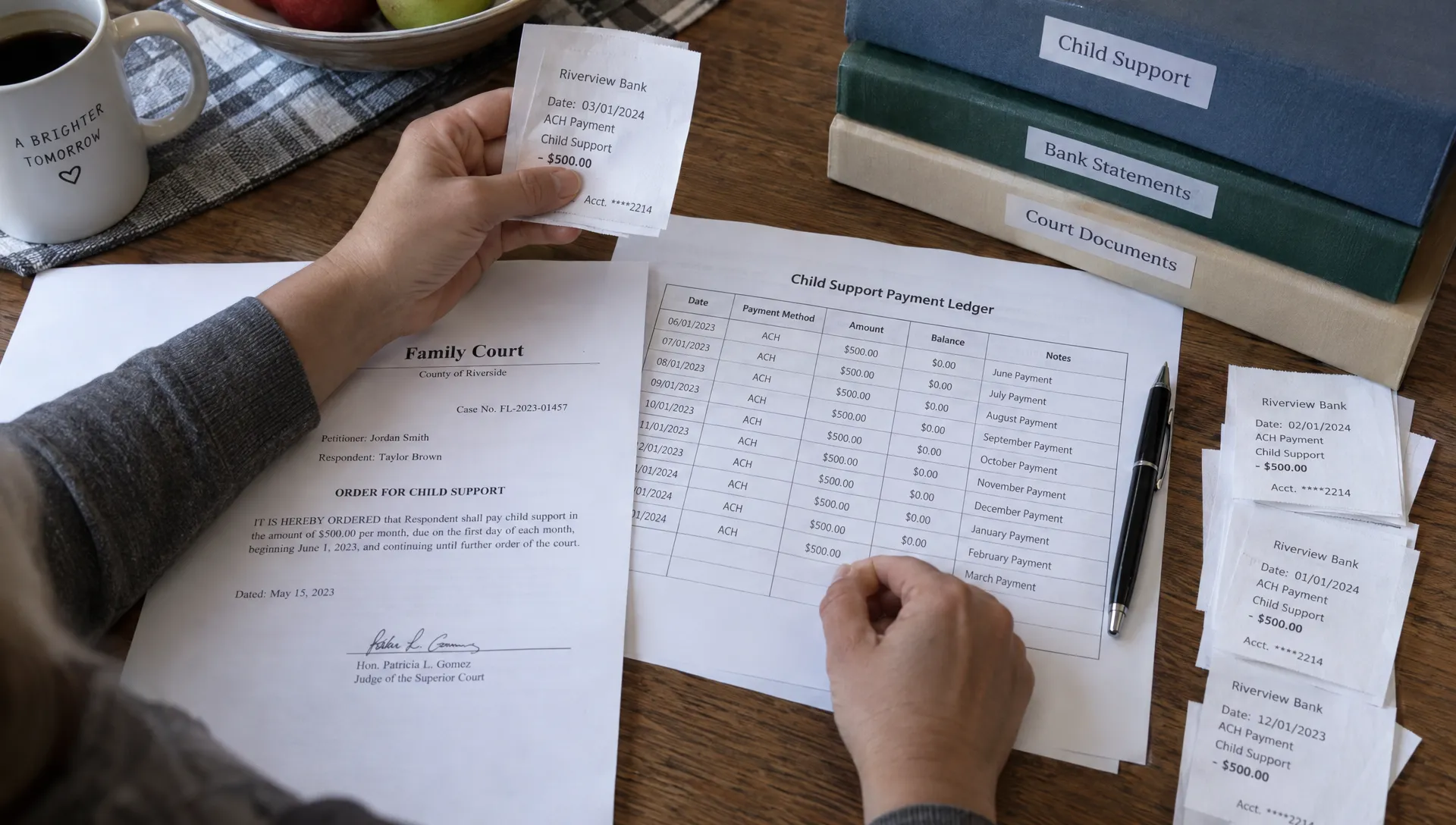
Before reporting missed child support, compare your bank deposits with the official payment history. The state disbursement unit, agency or court payment registry may have a record that differs from your own, particularly if payments are still processing or were made directly.
Prepare a short, organized file containing:
- The current order: Include later modifications and any separate medical support provisions.
- The official payment ledger: Identify the dates and amounts you believe are missing.
- Proof of direct payments: Keep receipts, canceled checks or transaction records for money paid outside the usual system.
- Useful location or employment information: Provide information you lawfully have about the other parent’s address, employer or business.
- Expense documentation: Include bills and reimbursement requests if you are seeking payment of ordered healthcare or childcare costs.
Ask for an itemized balance separating current obligations, past-due principal, interest and fees where applicable. An incorrect balance should be addressed rather than carried into a hearing or collection action.
You can find the appropriate office through the federal state and tribal agency directory. Keep your case number handy and confirm how the office accepts supporting documents securely.
The main tools agencies use to collect overdue payments
There is no single nationwide enforcement sequence. An agency may use several tools at once, depending on the order, overdue balance, available income and applicable notice requirements.
| Enforcement tool | How it works | Important limitation |
|---|---|---|
| Income withholding | An employer deducts money from wages and sends it through the designated payment system | Withholding limits apply, and employment information must be available |
| Tax refund offset | An eligible tax refund is intercepted and applied to qualifying arrears | Federal and state programs have different eligibility rules |
| Financial account levy | Funds in an identified account may be frozen or taken through a legal process | Exempt funds, ownership issues and challenge rights can affect collection |
| Property lien | A claim is placed against qualifying property to secure overdue amounts | A lien does not necessarily produce an immediate payment |
| License-related action | A qualifying delinquency may lead to restrictions on certain licenses | Thresholds, exceptions and reinstatement rules vary |
| Court enforcement | A judge considers remedies after the required filings and notice | The available remedy depends on the evidence and legal standards |
Enforcement authority is not a guarantee of immediate payment. Child support collection can be difficult when a parent has no reachable wages, limited assets or income that is hard to document. Giving the agency accurate information is useful, but it still must follow the required process.
Wage withholding and financial collection
Income withholding is often the most practical way to collect regular payments. It may already be part of the order, even when no delinquency exists. When arrears accumulate, withholding may also include an additional amount toward that balance.
If payments stop after a job change, the agency may need to identify the new employer and send the appropriate notice. Self-employment presents a different problem because there may be no employer payroll department to make deductions.
Federal law limits how much of a worker’s disposable earnings can be withheld for support. The Department of Labor’s garnishment guidance explains those limits. A large overdue balance does not allow an agency to take an entire paycheck.
Tax offsets and account levies have separate rules. A refund intercept may reduce arrears without fixing the ongoing monthly payment problem, and a bank account may contain protected funds or money belonging partly to someone else.
License restrictions, credit reporting and passports
Depending on state law and case eligibility, an agency may report delinquency to credit bureaus or seek restrictions on a driver’s, professional or recreational license. These measures are not automatic after every missed payment. Notice and procedures for contesting the action generally matter.
Federal passport rules are separate. The State Department explains that a person who owes at least $2,500 in child support may be ineligible for a U.S. passport. Resolving a passport restriction requires working with the responsible enforcement agency, not simply explaining the situation at a passport appointment.
If a license restriction would prevent employment, promptly ask about available review procedures, exceptions or payment arrangements. Do not assume a private agreement with the other parent automatically lifts an agency restriction.
When enforcement reaches a court hearing
If administrative collection is unsuccessful or inappropriate, the agency or a parent may seek judicial enforcement. Depending on the jurisdiction, the filing might be called a motion to enforce, a contempt petition or an order to show cause.
A hearing can address the unpaid balance, compliance with the existing order and appropriate remedies. Bring the order, payment records, relevant notices and financial documentation. If you are accused of nonpayment, respond by the stated deadline rather than assuming the agency already knows your circumstances.
Missing a payment does not automatically lead to jail. Civil contempt is intended to compel compliance, and ability to comply is a critical issue. Federal enforcement regulations require state agencies to screen for ability to pay before pursuing civil contempt and to provide relevant information to the court.
Criminal nonsupport proceedings are separate and involve additional legal requirements. Anyone facing possible incarceration should promptly seek legal help and ask about available counsel. The right to appointed counsel depends on the proceeding and applicable law.
What happens if the other parent moves out of state?
Moving across state lines does not erase an existing order or its unpaid balance. States use the Uniform Interstate Family Support Act, commonly called UIFSA, to coordinate enforcement and determine which tribunal has authority over particular issues.
Depending on the circumstances, an income withholding notice can reach an out-of-state employer, or an order may be registered for enforcement in another state. Registration is generally a way to recognize and enforce an existing order, not permission to recalculate it from scratch.
For interstate child support cases, start with the office handling your current case. Ask whether it needs assistance from another jurisdiction and which agency will provide updates. Opening duplicate cases without coordination can create confusion about balances and responsibility.
If the other parent is abroad, collection depends on the country involved and available international arrangements. Ask the agency about its international services rather than assuming domestic procedures apply unchanged.
If you cannot afford the ordered payment
A job loss, serious illness or reduced work schedule may justify requesting a modification, but it generally does not change the order automatically. An enforcement dispute and a request to change future payments are different matters. You may need to address both at the same time.
File the appropriate request promptly and keep proof of filing and required notice. Under federal requirements governing support orders, installments that have already come due generally cannot be retroactively reduced. Any permitted adjustment for a period when a modification request is pending depends on applicable law and notice requirements.
Until a change takes effect, pay what you can through the required channel, document it and understand that partial payments generally do not prevent the remaining amount from becoming overdue. Tell the agency about unemployment benefits, a disability claim or other relevant financial changes.
For preliminary planning, Child Support Estimate offers free calculators using simplified state guidelines and tools covering modifications and arrears. An estimate can help organize your questions, but it cannot change a court order or establish the official debt balance.
How long does enforcement take?
There is no reliable nationwide deadline for recovering missed child support. A case with a known employer and a functioning withholding order is different from one involving disputed payments, interstate coordination or hidden assets.
A new withholding notice must reach the employer and enter its payroll process. A levy may involve notice and an objection period. Court proceedings require filing, service and an available hearing date. Even a successful collection action may recover only part of the balance.
When following up, ask specific questions: Has the employer received the notice? Is the case waiting for financial information? Has a hearing been requested? Is there anything you must submit before the next step can occur?
Keep a dated communication log and copies of submissions. If the case appears stalled, ask about supervisory review or the agency’s complaint process. An agency’s role is to administer and enforce the program; it is not a substitute for your own legal adviser.
Frequently asked questions
Does overdue support disappear when the child turns 18? Not automatically. The end of the current payment obligation and the collection of existing arrears are separate issues. The termination date depends on the order and applicable law, while unpaid amounts may remain collectible afterward.
Can a parent stop paying because parenting time is being denied? Generally, no. Payment obligations and parenting-time enforcement are separate. A parent should seek the appropriate remedy for a custody or visitation violation rather than withhold payments. Likewise, missed payments generally do not authorize the receiving parent to disregard a parenting-time order.
Does interest accrue on unpaid child support? It can. States differ on whether interest applies, the rate and how it is assessed. Ask for an official itemized balance instead of assuming an online calculation matches the agency’s records. Options for adjusting interest or state-owed debt also vary.
What if money was deducted from a paycheck but never arrived? Keep the pay stubs and contact the agency or disbursement unit promptly. The issue could involve processing, an incorrect case identifier or an employer’s failure to remit withheld funds. Do not assume a missing deposit proves that the paying parent failed to authorize or make a payment.
Choose the next step based on your case
Start with the current order and official ledger, then ask the responsible office which enforcement action is available and what it needs from you. If you are behind, address notices and request a review of the payment amount when appropriate rather than waiting for the balance to grow.
For a disputed balance, interstate complication or possible contempt hearing, the site’s state-by-state attorney resources can help you explore legal assistance. This article provides general information, not legal advice about a particular case.