How to Use a Visitation Calculator for Alternating Weekends
Use a visitation calculator to count alternating-weekend overnights, adjust for holidays and avoid double counting before estimating child support.
Child Support Estimate ·

A visitation calculator can turn an alternating-weekend schedule into an annual parenting-time estimate, but the result depends on what you enter: exchange times, holidays, vacations and the counting method. For a parent with Friday-to-Sunday visits every other weekend, a common starting estimate is 52 overnights per year, or about 14.25% of a 365-day year. That assumes 26 weekends with two overnights each, before schedule exceptions.
Use the steps below to build that baseline, adjust it without double counting and check whether the result is suitable for a child support estimate.
Start with the exact every-other-weekend schedule
“Alternating weekends” means a repeating two-week rotation. It does not necessarily mean the first and third weekends of each month. Those schedules can produce different dates, especially in months with five weekends.
Start with the written parenting plan or court order, if one exists. Identify which parent receives the first weekend in the rotation, when exchanges happen and whether the schedule continues unchanged during school breaks.
For example, a 2026 rotation beginning Friday, January 9 would continue on January 23 and February 6. Selecting the first and third Fridays of each month would not preserve that same pattern throughout the year.
Also establish what “weekend” includes. Friday after school through Sunday evening usually contains two overnights. Friday evening through Monday morning usually contains three. A Sunday dinner visit adds time but no overnight.
Write the schedule as dates and exchange times, not just “every other weekend.” That makes the calculation easier to verify and gives both parents a clearer record of the assumptions.
Enter the schedule in a visitation calculator
Tools vary. Some generate calendars, while others accept an annual number of overnights or a parenting-time percentage. Check what the tool requires before entering your information.
Choose the year and starting weekend
Select the calendar year you want to measure. A standard year has 365 days; a leap year has 366. If the tool instead uses a rolling 12-month period, make sure that matches your purpose.
Enter a known weekend from the agreed rotation and select an every-two-weeks recurrence, if available. Preview several dates, including a month with five Fridays, to confirm the pattern.
If the tool accepts only an annual total, work out the schedule on a calendar first. Do not enter 52 automatically just because the arrangement is described as alternating weekends.
Match exchange times to the counting method
Enter the actual start and end times when the tool supports them. “After school” may need a specific time for an hourly calculation, while an overnight calculation generally focuses on where the child stays overnight, subject to the applicable rules.
Check whether your visitation calculator measures overnights, hours or calendar days. These are not interchangeable. A Friday-to-Sunday visit touches three calendar dates but normally includes only two overnights.
If the interface asks for a percentage rather than a schedule, calculate that percentage using the required method first. Entering a count of calendar dates into a field intended for overnights can substantially overstate parenting time.
Check the baseline: overnights versus hours
For an overnight-based estimate, use:
Annual parenting-time percentage = assigned overnights ÷ total nights in the year × 100
The following examples assume exactly 26 scheduled weekends, a 365-day year and no holidays, vacations or other changes.
| Repeating weekend | Overnights per visit | Hours per visit | Annual overnights | Overnight percentage |
|---|---|---|---|---|
| Friday 6 p.m. to Sunday 6 p.m. | 2 | 48 | 52 | 14.25% |
| Friday 6 p.m. to Monday 8 a.m. | 3 | 62 | 78 | 21.37% |
An hourly percentage can differ. The Friday-to-Monday example produces 1,612 hours across 26 visits. Dividing that by 8,760 hours in a standard year gives about 18.40%, rather than the overnight result of 21.37%.
Neither number should automatically replace the other. The correct input depends on the calculation’s purpose and the applicable rules.
When checking a visitation calculator result, confirm the denominator as well as the numerator. For example, 52 overnights divided by 366 nights in a leap year is about 14.21%. Keep the exact overnight count in your records, even if the tool rounds the displayed percentage.
Finally, treat 26 weekends as a planning baseline, not a substitute for reviewing the actual calendar. Year boundaries can split a visit between two years.
Replace regular weekends with holidays and vacations
Holiday and vacation provisions often override the ordinary rotation. Follow the priority rules in the parenting plan rather than adding every special period on top of every regular weekend.
The key calculation is:
Net additional nights = special-period nights − nights already included in the baseline
Suppose a 14-night summer block includes four nights that already belong to the same parent under the alternating-weekend schedule. The block adds 10 nights, not 14. Adding all 14 would count those four nights twice.
Use the same approach when a holiday gives the other parent time that otherwise belonged to you. Your visitation calculator should reflect the replacement, not show both parents receiving the same overnight.
Here is a hypothetical annual adjustment for a parent whose baseline is 52 nights. Assume the special periods do not overlap one another.
| Schedule component | Adjustment | Running total |
|---|---|---|
| Regular alternating weekends | 52 nights | 52 |
| Summer block: 14 nights, including 4 already counted | +10 nights | 62 |
| Winter break: 4 nights, including 2 already counted | +2 nights | 64 |
| Separate holiday override transfers 2 baseline nights to the other parent | -2 nights | 62 |
The final result is 62 ÷ 365 × 100 = approximately 16.99%.
Unless the parenting plan says otherwise, do not assume a holiday interruption restarts the alternating-weekend rotation. Continue the underlying pattern and apply each exception to its specific dates.
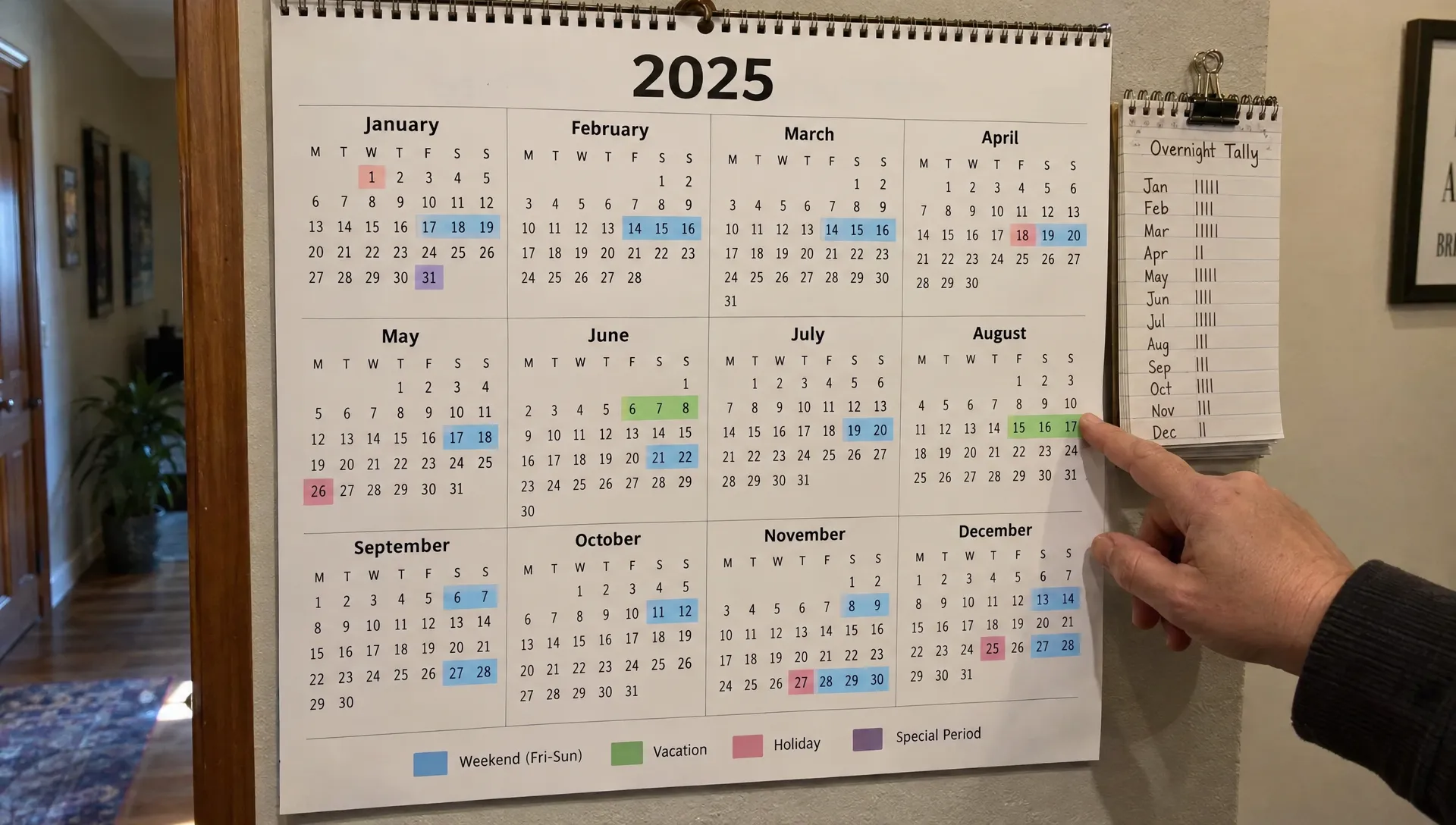
Audit the year before using the percentage
Before relying on the annual total, review the calendar month by month. This is especially useful when one parent has holiday time in odd-numbered years and the other has it in even-numbered years.
Check these common sources of error:
- Year boundaries: Count only the portion of a late-December or early-January visit that falls within the year being measured, using the relevant counting convention.
- Overlapping exceptions: Resolve conflicts between summer vacation, holidays and regular weekends according to the parenting plan.
- Missed or exchanged visits: Record what changed and whether the calculation calls for scheduled time or time actually exercised.
- Additional visits: Include applicable weekday overnights or other recurring periods that are not part of the weekend rotation.
A visitation calculator is easier to verify when you save both the total and the assumptions behind it. Keep a dated copy of the calendar, the exchange times and a short explanation of each adjustment.
If you are comparing ordered time with actual time, maintain separate totals. Do not silently substitute one for the other. Which figure matters for a support proceeding depends on the jurisdiction and circumstances, not simply on which total seems more representative.
Use parenting time as one input to child support
An annual parenting-time percentage is not a universal child support discount. A result of 17% does not mean support automatically falls by 17%.
State rules differ in how they account for parenting time. For example, Minnesota’s parenting expense adjustment statute addresses parenting-time percentages and overnight equivalents. That is a reason to check the applicable state rule rather than assume every jurisdiction uses a simple overnight fraction in the same way.
A visitation calculator can help establish the schedule input, but a support estimate may also require each parent’s income, the number of children and allowable healthcare or childcare expenses. Two families with identical weekend schedules can therefore have different estimated support obligations.
Before transferring your result into a support tool, check whether it asks for annual overnights, a percentage or another measure. Use the requested unit and avoid rounding the overnight count itself.
If a disagreement about exchange times or holiday priority changes the annual total, resolve that interpretation before treating the resulting support estimate as reliable. A calculator cannot determine which interpretation of a parenting order is legally correct.
Frequently asked questions
Does every other weekend equal 25% parenting time? Not for a typical Friday-to-Sunday overnight schedule. Two nights every two weeks is roughly 14% of overnights. The final annual percentage changes with the calendar, longer weekends, holidays and other parenting periods.
Should I count Friday, Saturday and Sunday as three days? Those are three calendar dates, but a Friday-evening-to-Sunday-evening visit generally contains two overnights and 48 hours. Use the counting method required for your purpose rather than treating dates, nights and hours as equivalent.
What if my visitation calculator gives a different result from 52 nights? Check the selected year, starting weekend, exchange times and exceptions. Also inspect visits that cross New Year’s Day. A different result may reflect the actual calendar rather than a mistake, but you should be able to trace every assigned night.
Should I enter scheduled visits or visits that actually happened? Use the measure required by the relevant state rules or proceeding. For personal planning, you can track both, clearly labeled. Do not assume missed visits automatically change an existing support obligation.
Can a parenting-time estimate change a court order? No. Calculating a different percentage does not itself modify custody, visitation or child support. Any required agreement or court process remains separate from the estimate.
Turn your checked schedule into a support estimate
Once you have verified the annual count, use Child Support Estimate to explore a free estimate based on simplified guidelines for your state. Enter parenting time in the requested format, along with parent incomes and applicable expenses.
Keep your calendar calculation alongside the result so you can explain the inputs. The output is a planning estimate, not legal advice or a court-ordered amount.