Does Equal Custody Mean Neither Parent Pays Child Support?
Does equal custody mean no child support? Learn how income, shared expenses and state rules affect 50/50 payments and when to request a change.
Child Support Estimate ·

Having equal custody does not automatically mean neither parent pays child support. Even with a true 50/50 parenting schedule, one parent may owe support because of income differences, childcare costs, health insurance expenses or the way the state’s formula works.
Equal parenting time and equal financial responsibility are not the same thing. A schedule tells you when each parent cares for the child. A support calculation determines how the parents should share financial responsibility under the applicable law.
If you already have a support order, moving to a 50/50 schedule does not automatically cancel it.
What does a 50/50 custody arrangement actually mean?
Custody terminology varies by state, but two distinctions matter for this question.
Legal custody concerns decision-making, such as choices about education and medical care. Joint legal custody does not necessarily mean the child spends half their time with each parent.
Physical custody or parenting time concerns where the child lives and when each parent provides day-to-day care. A genuinely equal schedule generally divides that time approximately in half, although states may measure time differently for support purposes.
The label on a parenting plan is therefore not enough. A court may need the actual schedule, each parent’s income and qualifying expenses before determining support.
Why equal custody can still require child support
Children have expenses that do not divide neatly by overnight. Both households may need bedrooms, clothing and transportation. Meanwhile, one parent might earn substantially more or pay most of the child’s insurance and work-related childcare costs.
Many state formulas account for both parents’ incomes and some measure of parenting time. Others use different starting points or allow adjustments for shared care. A parenting-time adjustment can reduce a payment without eliminating it.
For example, a higher-earning parent may still owe support when the child spends half the year in each home. The calculation may also credit that parent for eligible expenses they pay directly. Whether those credits offset the payment depends on the state’s worksheet and the facts.
Courts also use state-specific definitions of income. Depending on the rules, relevant income may include wages, bonuses, self-employment earnings or other sources, with specified deductions. Comparing take-home pay alone can produce a misleading estimate.
The practical question is not simply whether time is equal. It is what the applicable guideline produces after all required inputs and adjustments.
State rules determine how a shared schedule affects support
There is no single nationwide rule that makes equal custody a child support exemption. Custody presumptions and child support calculations are separate legal questions, even when both arise in the same case.
California: income and parenting time both matter
The California Courts’ child support guidance explains that the guideline considers factors including parents’ earnings and how much time each spends with the child. Equal time does not, by itself, answer whether support is owed. Income differences and other required inputs still matter.
Washington: residential time can support a deviation
Under Washington’s residential-schedule deviation statute, a court may deviate from the standard calculation when a child spends a significant amount of time with the paying parent. The statute also imposes limits, including protection for the child’s basic needs in the household receiving support.
That is different from an automatic cancellation based on a custody label.
Before relying on a general example, identify the governing state and consult its current official worksheet or court guidance. The website’s state-by-state child support guidelines directory provides a starting point, but an estimate should be checked against current official rules.
A simple example: equal time, different incomes
A hypothetical expense split shows why equal custody does not necessarily mean each parent should pay the same dollar amount.
Assume the applicable calculation recognizes monthly income of $6,000 for Parent A and $3,000 for Parent B. Their combined income is $9,000. Parent A earns two-thirds of that amount and Parent B earns one-third.
Now assume there is a $900 monthly qualifying childcare expense. If the applicable order allocates that expense in proportion to those incomes, the shares would look like this:
| Item | Parent A | Parent B |
|---|---|---|
| Monthly income used in this example | $6,000 | $3,000 |
| Share of combined income | Two-thirds | One-third |
| Parenting time | 50% | 50% |
| Proportional share of the $900 expense | $600 | $300 |
If Parent B initially pays the entire bill, Parent A’s allocated share would still need to be accounted for.
This is an illustration of expense allocation, not a child support calculation. An actual worksheet may integrate childcare into the monthly transfer, apply credits or use another method. The example does not establish a base support amount, and the same expense should not be counted twice.
When could the payment be low or zero?
A zero-dollar result may be possible when parents have similar guideline incomes, comparable parenting time and an expense allocation that does not produce a transfer under the state’s rules. It is not guaranteed.
With equal custody, the factors that can move the result away from zero include:
- A meaningful difference in the parents’ guideline incomes.
- One parent paying eligible health insurance premiums or work-related childcare.
- State-specific minimum obligations, adjustments or shared-parenting rules.
- A court’s decision to attribute income or approve a permitted deviation.
Attributing, or imputing, income means using an earning amount recognized under state law rather than simply accepting reported earnings. The standards vary, so unemployment or reduced hours do not automatically settle the income question.
Likewise, a private agreement to split everything down the middle does not necessarily match the guideline result. Some expenses may be allocated proportionally rather than equally.
A useful comparison is the complete financial arrangement: the monthly transfer, who pays recurring bills and how eligible additional expenses are divided. Looking only at the transfer can hide a substantial imbalance.
What if your schedule recently changed to 50/50?
If you already pay support, do not assume a new equal custody schedule gives you permission to stop. An existing support order remains enforceable until it is changed through the applicable legal process.
A parenting-time change may support a modification request, but states set their own standards. The court may consider whether the change is substantial, whether it is actually being followed and how much it changes the guideline amount. An income change or a new childcare arrangement may also matter.
Keep records of the operative order, the actual schedule, income information and eligible expenses. If you need to reconstruct parenting time, this guide to counting overnights for a custody percentage calculation explains how to account for holidays and schedule exceptions without double-counting.
Past-due support generally does not disappear because the child began spending more time with you. Effective-date rules also vary, so waiting to request a modification can have financial consequences.
Treat support and parenting-time disputes separately. Do not withhold ordered payments because of an exchange disagreement or deny parenting time because support is unpaid.
How to estimate support without missing major inputs
Start with the state whose support rules apply to the case, not simply the state where you most recently moved. If parents live in different states or there are multiple orders, jurisdiction may require legal review.
For an equal custody estimate, gather the information the applicable worksheet requires:
- Income information: Recent pay statements, relevant tax documents and records of bonuses or self-employment income.
- Parenting time: The schedule or time measure recognized by the state, including holidays and vacations where relevant.
- Child-related costs: Eligible insurance premiums, work-related childcare and other expenses recognized by the guidelines.
- Existing obligations: Current support orders and any other obligations the state permits the worksheet to consider.
Enter expenses according to the worksheet’s instructions. For example, the relevant insurance figure may be the child’s portion of the premium rather than the cost of the entire family policy.
Do not assume that paying for groceries, a bedroom or ordinary activities creates a dollar-for-dollar support credit. Similarly, buying clothes directly usually does not authorize reducing an ordered payment on your own.
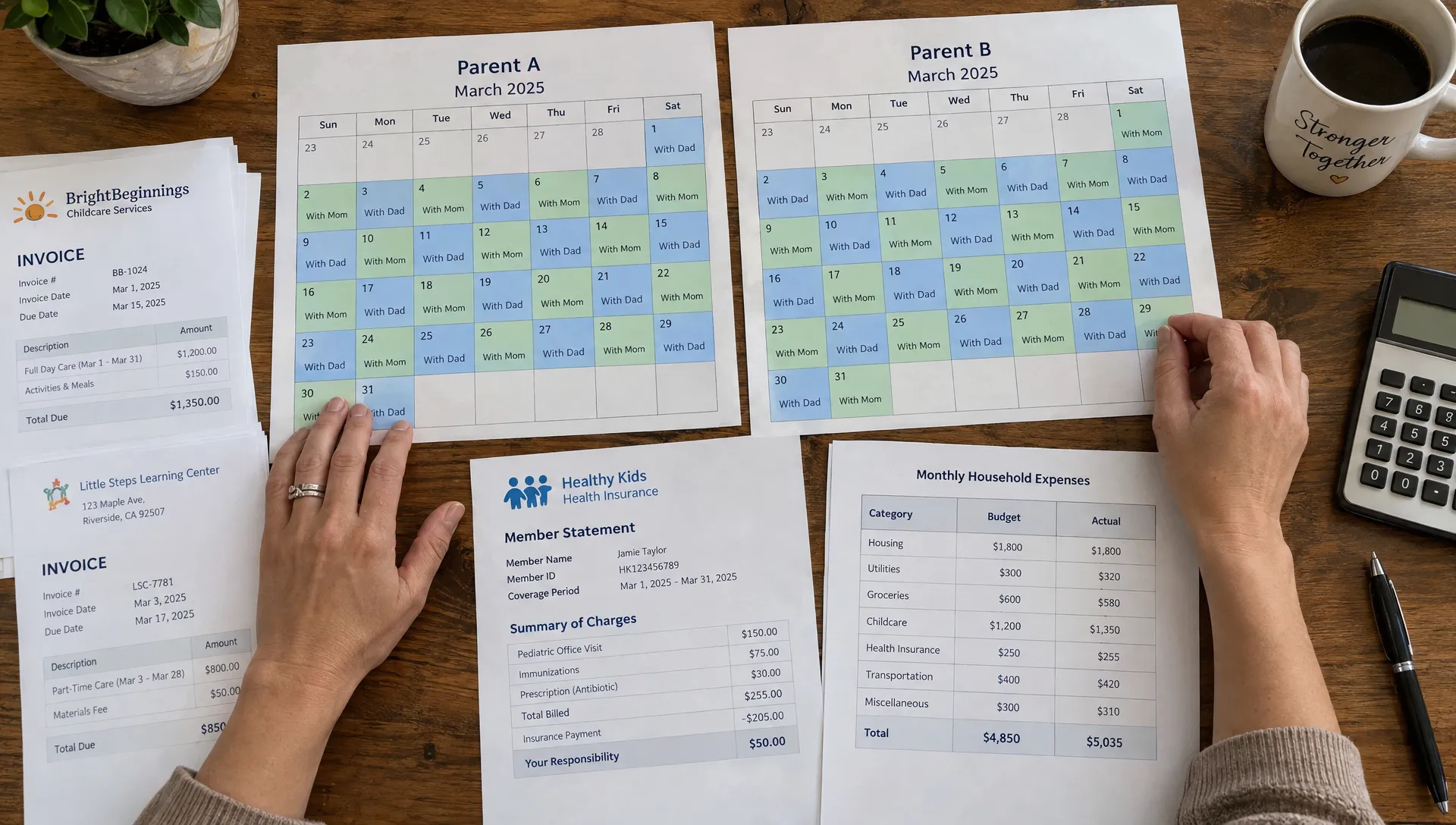
A calculator is most useful for comparing accurate scenarios. Run the actual arrangement first, then compare a proposed schedule or documented income change. Keep the assumptions visible so you can explain why the estimates differ.
Can parents agree that neither will pay?
Parents can propose a financial arrangement, but a private agreement does not necessarily resolve the legal obligation. In a court case, approval requirements and the standards for departing from guideline support vary by state.
An agreement based on equal custody should address more than a promise that each parent will cover costs during their own time. Childcare, insurance, unreimbursed medical bills and other shared expenses can continue regardless of which household the child is visiting.
A practical written proposal identifies who pays each bill, how reimbursement works and what documentation is required. It should also explain whether the arrangement follows the guideline or requests a deviation. A court may require findings before approving a different amount.
The parenting schedule itself should serve the child’s needs. School transportation, distance between homes and the child’s routines can affect whether a proposed arrangement works. Domestic violence or other safety concerns require separate attention, not a schedule chosen to reduce support.
Frequently asked questions
If we earn the same amount and have a 50/50 schedule, will support be zero? It may be, but matching incomes and time do not guarantee that result. Eligible expenses, state-specific adjustments and other required inputs can still produce a payment. Use the applicable guideline rather than assuming the obligations cancel out.
Does joint legal custody reduce child support? Joint legal custody concerns decision-making authority. It does not, by itself, establish equal parenting time or determine a support payment. The physical schedule and the state’s financial rules are more directly relevant to the calculation.
Does equal custody mean we split every expense 50/50? No. An order may allocate certain expenses according to income shares or another permitted method. It may also distinguish ordinary costs covered by support from separately reimbursable expenses. Check the order before assuming that half of every bill is owed.
Can a calculator replace a court order? No. A calculator provides an estimate based on its assumptions and the information entered. It does not establish, terminate or modify an enforceable obligation. If an order already exists, a different estimate alone does not change what you must pay.
Check the numbers before changing payments
A 50/50 schedule is one input, not a guaranteed zero-support outcome. Compare the parents’ guideline incomes, eligible expenses and the applicable state rules before drawing conclusions.
Use Child Support Estimate’s free state-specific calculators to explore how income, parenting time and expenses may affect a payment. The tools use simplified guidelines and provide estimates, not legal advice. Confirm the result with current official resources or a qualified family-law attorney before changing an existing obligation.