How to Use a Custody Percentage Calculator to Count Overnights
Use a custody percentage calculator to count overnights, adjust for holidays and vacations, and convert your parenting schedule into an annual percentage.
Child Support Estimate ·
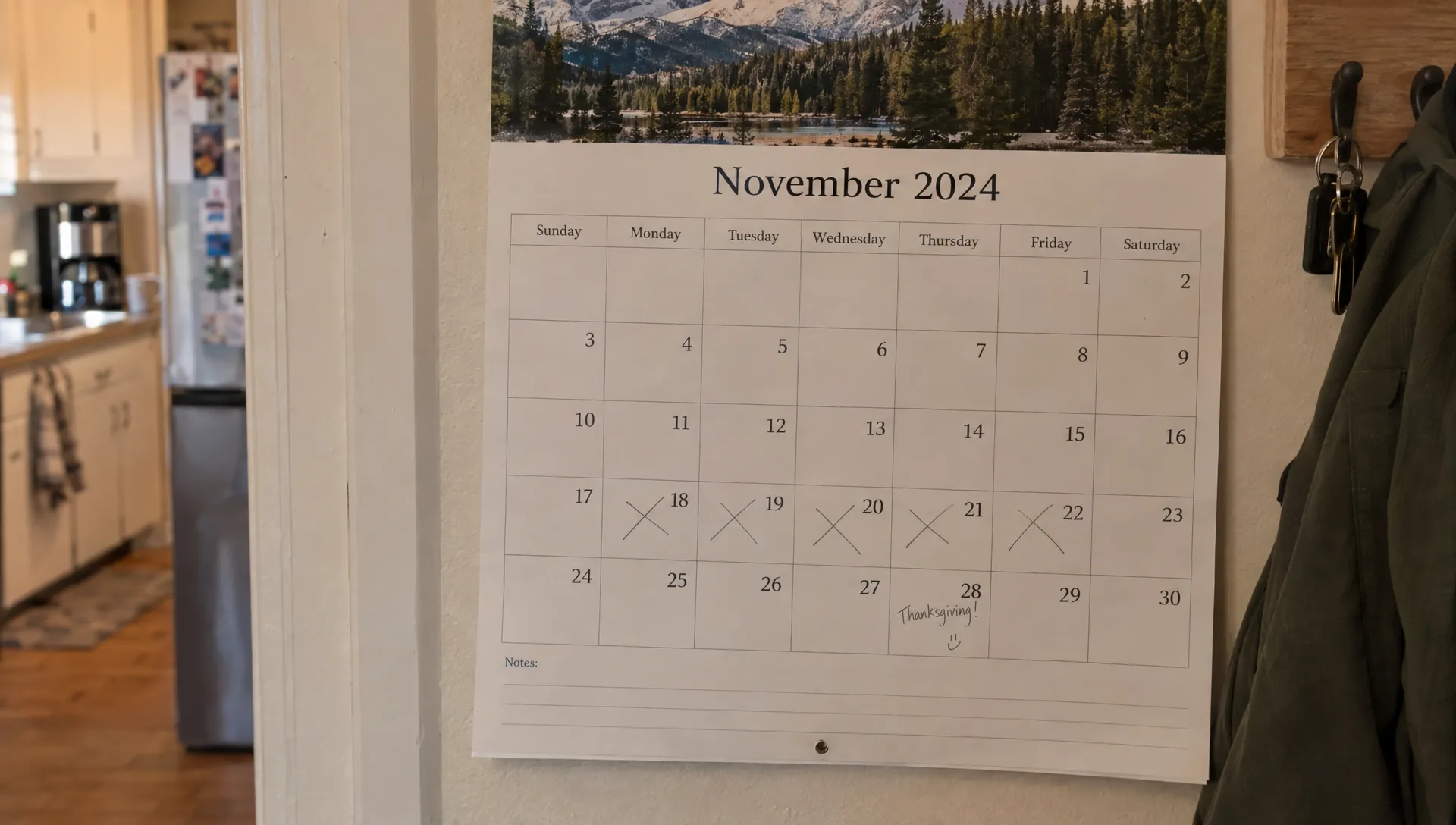
A custody percentage calculator turns parenting time into a number you can use when reviewing a schedule or estimating child support. For an overnight-based calculation, the basic formula is your annual overnights ÷ total nights in the year × 100. In a 365-day year, 146 overnights equals 40%.
The arithmetic is straightforward. Getting the overnight count right takes more care: holidays can replace regular weekends, summer schedules can override school-year routines and a repeating two-week schedule does not fit perfectly into a calendar year.
This guide walks through a calendar-based method, shows how to avoid counting the same night twice and explains what common percentages mean. Before using the result for a legal or financial decision, confirm that your state uses overnights rather than hours or another parenting-time measure.
What a custody percentage calculator actually measures
For an overnight-based calculation, the percentage describes the share of nights assigned to a parent during a defined period. It does not establish legal custody, decision-making authority or a right to change an existing parenting plan.
Start by choosing your calculation period. For the 2026 calendar year, use 365 nights. A leap year, such as 2028, has 366. If a worksheet requests a different period or an annualized schedule, follow those instructions instead.
Next, check the counting rule. Some jurisdictions use overnights, while others consider hours, days or equivalent care. Your state’s child support guidelines are a useful starting point for identifying the applicable approach.
A custody percentage calculator is only useful when its input matches that rule. If it requests a percentage based on hours, an overnight percentage may not be an appropriate substitute.
Also decide whether you are measuring the ordered schedule, a proposed schedule or parenting time actually exercised. Keep those calculations separate. Which one belongs on a legal worksheet depends on the applicable rules and facts.
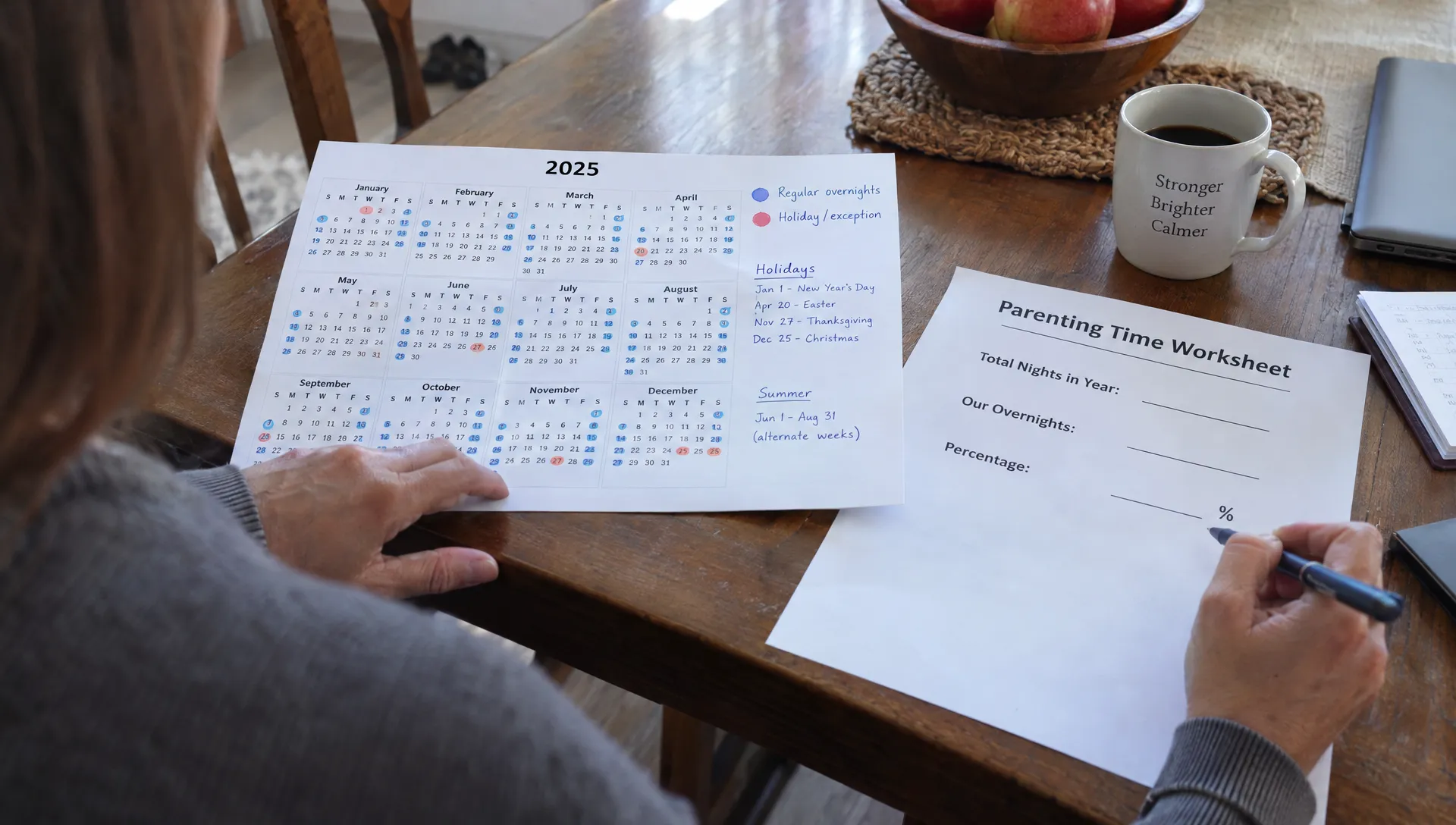
How to count overnights step by step
1. Put the regular schedule on an actual calendar
Choose one child and one parent to count first. Mark each overnight under the regular schedule, using the relevant start date and exchange pattern.
Do not assume every year contains exactly 52 weeks. That shortcut accounts for only 364 days. The remaining date, or two dates in a leap year, can change the total depending on where it falls in the rotation.
For a schedule that repeats every 14 nights, identify which parent has each night of the cycle, then extend that pattern through the selected period. Our guide to counting alternating-weekend parenting time covers that specific arrangement in more detail.
A custody percentage calculator may ask for annual overnights or an already-calculated percentage. Prepare the calendar count first rather than assuming the tool will interpret your full parenting plan.
2. Replace regular nights with holiday and school-break assignments
Read the parenting plan’s provisions about which schedule takes priority. Holiday, vacation and school-break provisions may override the usual rotation.
For each exception, compare the special assignment with the night’s original assignment. If the same parent already had that night, the annual total does not increase. If the night moves from one parent to the other, subtract it from one total and add it to the other.
For example, a seven-night vacation that includes three nights already assigned to you adds four net overnights, not seven.
Use the actual school calendar when a break’s dates depend on dismissal and return dates. Also check whether holiday assignments change between odd-numbered and even-numbered years.
3. Resolve unusual nights before totaling
Flag any dates that do not fit neatly into the ordinary schedule. These might include overnight travel, camp, hospitalization or a child staying with a grandparent.
Do not automatically assign every third-party overnight to whichever parent arranged it or assume that it belongs to neither parent. Treatment can depend on the order and the applicable counting rules.
For your own working calendar, use a consistent date label, such as labeling each overnight by the evening on which it begins. That is a recordkeeping convention, not a legal definition.
Before entering numbers into a custody percentage calculator, resolve any disputed counting assumptions or clearly label them as assumptions. A precise-looking result cannot fix an uncertain input.
4. Calculate both parents’ shares
Once each night has been assigned under the applicable method, total the nights and apply the formula:
Parent’s percentage = assigned overnights ÷ total nights in the period × 100
For a conventional two-parent overnight allocation covering a full non-leap year, the totals should equal 365. If one parent has 146 nights, the other has 219. Their percentages are 40% and 60%.
Keep the unrounded result until the final step. Follow the receiving form’s instructions for decimal places rather than rounding early to reach a preferred label.
If different children follow different schedules, calculate each child separately. Do not average their percentages unless the relevant worksheet specifically instructs you to do so.
Worked example: regular rotation plus exceptions
Suppose a parent maps the regular schedule onto a 365-night calendar and counts 130 overnights. After reviewing the holiday and vacation provisions, the parent identifies several changes.
The following figures are hypothetical. Each adjustment refers to separate dates, so no holiday or vacation night appears twice.
| Calendar item | Change to the parent’s total | Running total |
|---|---|---|
| Regular schedule, counted on actual dates | 130 nights | 130 |
| Holiday nights transferred from the other parent | +14 nights | 144 |
| Additional summer nights, excluding existing nights | +10 nights | 154 |
| Nights transferred to the other parent for other exceptions | -6 nights | 148 |
The final calculation is:
148 ÷ 365 × 100 = 40.55%, rounded to two decimal places.
The other parent has 217 nights, or 59.45%. Together, the counts equal 365 nights and the percentages equal 100%.
This is the number to enter into a custody percentage calculator if it requests an annual overnight percentage and those assumptions match its instructions. If it requests nights instead, enter 148 rather than 40.55.
Notice that the regular rotation alone would have produced 35.62%. The exceptions changed the result by nearly five percentage points. That is why counting only the recurring schedule can miss a meaningful part of the year.
How many overnights are 20%, 30%, 40% or 50%?
To work backward from a percentage, multiply the total nights in the year by the percentage expressed as a decimal. For example, 365 × 0.40 = 146.
| Parenting-time share | Mathematical equivalent in a 365-night year | Nearby whole-night count |
|---|---|---|
| 20% | 73 nights | 73 |
| 30% | 109.5 nights | 109 or 110 |
| 40% | 146 nights | 146 |
| 50% | 182.5 nights | 182 or 183 |
| 70% | 255.5 nights | 255 or 256 |
A 70/30 arrangement therefore generally means approximately 255 to 256 nights with one parent and 109 to 110 with the other in a 365-night year. Those are mathematical reference points, not a prescribed schedule.
Likewise, 20% means 73 nights in that year, but the percentage does not tell you when those nights occur. They could be spread throughout the year or concentrated in school breaks.
Because 365 is odd, two parents cannot each have exactly half of the whole overnights in a single calendar year. A balanced repeating schedule can still be described as 50/50 even if that year’s count is 182 nights for one parent and 183 for the other.
Check these common counting mistakes
Counting visits instead of overnight stays
An afternoon visit is not automatically an overnight. Neither is a dinner visit that ends before the child returns to the other home to sleep.
Conversely, counting every calendar date touched by a visit can overstate time. A Friday-evening pickup followed by a Sunday-evening return generally includes two overnight stays, even though it touches three dates. Apply your jurisdiction’s definition when making the legal calculation.
Keep exchange times in your records. They can matter when the applicable method measures hours rather than nights.
Mixing planned time with actual time
A parenting plan might assign a night to one parent even though the child stayed with the other. Keep the scheduled assignment and the actual stay in separate records rather than silently replacing one with the other.
For personal tracking, you can maintain both totals. For a court filing or support review, verify which measure is required. A custody percentage calculator does not decide whether missed visits, informal swaps or make-up time legally change the support calculation.
Save relevant calendar entries, written agreements and exchange records if the count may be disputed. Recording a disagreement is more useful than presenting an unsupported total as settled fact.
Rounding into a different schedule label
A result of 39.6% is not automatically 40% for every purpose. A worksheet may require whole nights, a particular rounding method or another measure entirely.
Use the underlying count when checking any rule tied to a parenting-time threshold. Avoid rounding first and then treating the rounded percentage as proof that a legal requirement has been met.
Using your overnight count for a child support estimate
Parenting time is one input, not the entire support formula. Depending on the state, the calculation may also consider parents’ incomes, the number of children, eligible childcare expenses and health insurance costs.
For example, California Courts’ child support guidance explains that parents’ incomes and the time each spends with the child affect support. Other states apply their own formulas and parenting-time adjustments.
A custody percentage calculator helps organize the time input, but a 40% share does not necessarily mean a 40% reduction in support. Equal parenting time also does not automatically eliminate a payment obligation.
When comparing proposed schedules, keep income and expense assumptions unchanged so you can identify the effect of the parenting-time change. Treat the resulting payment as an estimate rather than a guaranteed court outcome.
If the schedule or counting method is disputed, get state-specific legal guidance before relying on the number in negotiations or a filing. A calculator result does not modify an existing custody or support order.
Frequently asked questions
How many overnights is 40% custody? In a 365-night year, 40% equals 146 overnights. In a 366-night leap year, it equals 146.4 nights mathematically, so a whole-night schedule will not land at exactly 40%.
Can I calculate custody percentage from a two-week schedule? Yes. Divide one parent’s nights in the cycle by 14 and multiply by 100 to find the repeating-cycle percentage. For an annual result, count the actual calendar dates and apply holidays, vacations and other exceptions.
Does joint custody mean the overnight split is 50/50? Not necessarily. Joint legal custody generally concerns shared decision-making, while physical custody and parenting schedules address where the child spends time. Terminology varies by state, so use the actual schedule rather than the label to count nights.
Should I enter a rounded percentage or the exact overnight count? Follow the tool or worksheet instructions. If a custody percentage calculator asks for nights, enter the count. If it asks for a percentage, calculate from that count and round only as instructed.
Turn your calendar count into an estimate
Once you have a checked overnight total, use Child Support Estimate to explore a free, simplified state-guideline estimate with income, parenting-time and eligible expense inputs. Keep your calendar and assumptions alongside the result so you can explain how you reached the number. The estimate is a planning aid, not legal advice or a court order.