How Florida Support Works When One Parent Lives Out of State
Florida support across state lines: learn which state can set or change payments, how enforcement works and where to check payment records.
Child Support Estimate ·

Florida support obligations do not disappear when a parent crosses a state line. Whether you are separating, moving for work or trying to collect missed payments, the central questions are which state can issue the order, which state can change it and how payments will reach the receiving parent. Those answers may involve two states, but moving does not automatically transfer the case or replace the existing order.
This guide addresses child support, not alimony. It explains the interstate process and the records to gather before contacting an agency or attorney.
The rules that connect child support cases across states
Florida uses the Uniform Interstate Family Support Act, usually called UIFSA, to coordinate support cases with other states. Florida’s version appears in Chapter 88 of the Florida Statutes.
The law separates three issues that parents often confuse:
- Establishing an order: Which state has authority to enter the initial support order?
- Enforcing an order: Which agencies or courts can help collect the amount already ordered?
- Modifying an order: Which state has authority to change the payment obligation?
A state may help collect payments without having authority to change the amount. For example, an employer in Georgia might withhold wages under a valid order issued in Florida without Georgia becoming the state that controls future modifications.
An interstate Florida support case also remains separate from custody jurisdiction. The rules governing where a child custody case belongs are not the same rules governing support. A child’s residence alone does not answer every jurisdiction question.
Which state can establish the first order?
If no order exists, the first issue is whether the court or authorized agency has personal jurisdiction, meaning legal authority over the parent who would owe support.
A child living in Florida does not, by itself, always give Florida authority to order an out-of-state parent to pay. UIFSA identifies several possible grounds, including the parent’s consent, personal service while in Florida or certain past connections with Florida involving the child. The facts matter, so do not assume that either parent’s current address settles the issue.
If Florida cannot establish the order directly, the state’s child support program may work with the other parent’s state to establish parentage and support there. The tribunal entering the initial order generally applies its own state’s support guidelines.
Before applying, tell the agency whether there is already a parentage judgment, pending support case or existing order anywhere else. Opening another case without disclosing those records can create avoidable delays.
If sharing your address could put you or your child at risk, ask about confidentiality protections before submitting paperwork. Interstate cooperation does not mean you should circulate sensitive information informally between households.
Does moving change a Florida support order?
Moving does not automatically change the amount, payment instructions or state authorized to modify the order. A valid order remains in effect until it is changed through the proper legal process.
Under UIFSA, the issuing state generally keeps “continuing, exclusive jurisdiction” to modify its order while the child or either parent still lives there. Legally valid consent can affect that result, so residence is the starting point rather than the only consideration.
| Situation | General starting point |
|---|---|
| Florida issued the order and one parent still lives in Florida | Florida generally retains authority to modify, subject to UIFSA’s requirements and consent provisions. |
| Florida issued the order and neither parent nor the child lives there anymore | Another state may become eligible to modify, but the applicable registration and jurisdiction requirements must be satisfied. |
| Another state issued the order and the child later moves to Florida | Florida does not automatically gain authority to change the order. |
For example, if a Florida order requires a parent who later moves to North Carolina to pay support while the other parent and child remain in Florida, the move alone does not replace the order with a North Carolina calculation.
Update your address and employment information through the required channels. Mail sent to an old address can contain hearing notices or deadlines that still require attention.
How the payment amount is calculated
When Florida law governs the calculation, the state generally uses an income-shares approach. The guideline calculation considers both parents’ net incomes, the number of children and qualifying expenses, including health insurance and childcare. Parenting time can also affect the result.
The governing calculation rules appear in Florida Statutes section 61.30. A Florida support estimate should therefore use the relevant income, expense and overnight information rather than one parent’s salary alone.
For parents living far apart, summer and holiday schedules deserve particular attention. Florida’s substantial-time-sharing calculation generally applies when each parent has at least 20% of annual overnights, equivalent to 73 nights in a 365-day year. Other adjustments or deviations may apply depending on the facts.
Count the full year rather than treating a long summer visit as the entire parenting schedule. Our guide to calculating summer parenting time explains how to avoid double-counting nights that overlap with a regular schedule.
Long-distance transportation costs can also be relevant to a requested adjustment. They are not permission to deduct airfare, fuel or hotel bills from an ordered payment on your own.
Finally, living in Florida does not necessarily mean Florida’s formula governs an existing out-of-state order. Determine which state has modification authority before comparing calculator results.
Where to pay and how to check payment records
Follow the payment instructions in the order, income-withholding notice or official agency correspondence. Do not switch payment destinations merely because a parent moves, and do not assume an informal transfer will receive automatic credit in the official ledger.
Several services have different roles:
Florida Department of Revenue Child Support Program: The program helps with services such as establishing, enforcing and reviewing support obligations. Start with the official Florida child support website to identify the appropriate service and contact route.
Child Support eServices: Eligible users can access case-related information through Florida’s official eServices portal. Access and available information depend on the case and account.
Florida State Disbursement Unit and county payment services: The State Disbursement Unit processes support payments. MyFloridaCounty provides certain county-linked payment and record services, but it is not interchangeable with the agency’s case-management portal. For a Florida support payment, use the service specified for your particular order.
On a phone, enter through an official website rather than a link in an unexpected text. Avoid sending Social Security numbers or account credentials through ordinary messages.
If wages are already being withheld, check the employer’s remittance and the official payment record before making an extra payment to cover an apparent gap. Ask the agency how to handle any amount due while a payment is being traced.
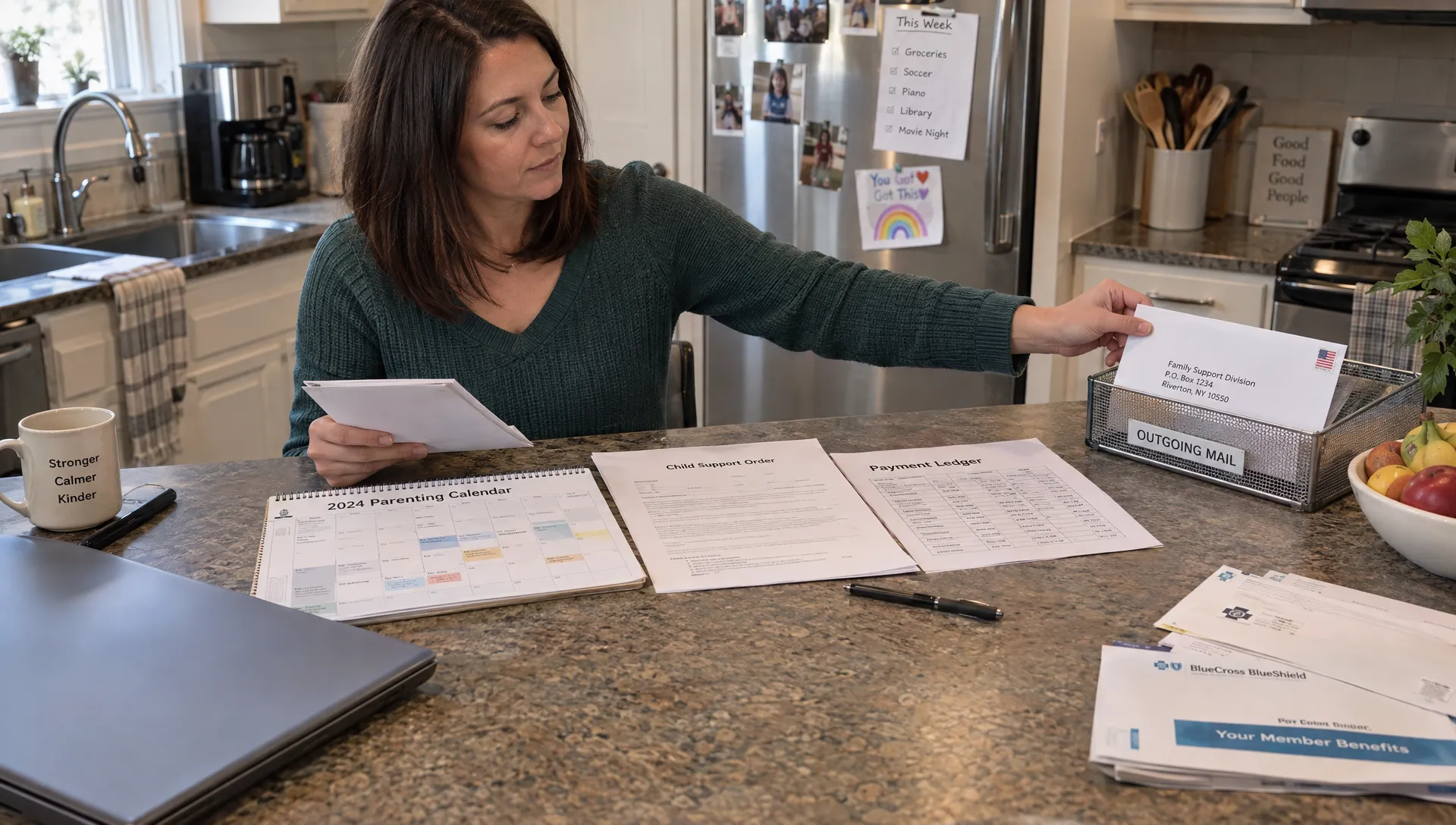
Enforcing payments when the paying parent lives elsewhere
A parent’s move does not prevent interstate collection. Depending on the case, enforcement may include income withholding sent to an out-of-state employer or cooperation with the child support agency where the paying parent lives.
Sometimes an order must be registered in another state. Registration allows that state’s tribunal to recognize the existing order for enforcement. It is not the same as entering a new support amount, and the receiving parent generally does not have to start the underlying support claim over from scratch.
Available enforcement measures can include withholding, liens, license-related actions or tax refund offsets when the legal requirements are met. None guarantees immediate collection, especially if employment, income or the parent’s location is uncertain.
For a missing Florida support payment, first distinguish between money withheld from wages, money sent by the employer and money posted or distributed by the processing agency. These are separate events.
Gather the payment date, amount, pay stub or receipt, transaction reference and case number before asking for a trace. Preserve a month-by-month ledger showing what was due and what was credited. If you received a direct payment, disclose it so the agency can determine how it should be recorded.
How to request a modification across state lines
A job loss, income increase or changed parenting schedule may justify asking for a review. It does not authorize either parent to substitute a new amount without an updated order.
Start by identifying the issuing state and where the child and both parents currently live. If Florida retains modification authority, its review process may remain the appropriate route even when one parent is elsewhere.
If everyone has left Florida, another state may be able to modify after registration. UIFSA’s requirements depend on who is requesting the change, where each person lives and whether legally valid consent exists. The requesting parent cannot simply choose the state with the most favorable calculator result.
A Florida support order registered elsewhere for collection also does not automatically become eligible for modification there. Enforcement authority and modification authority require separate analysis. Even after another state properly modifies an order, UIFSA can preserve certain rules from the original issuing state, including the duration of the support obligation.
Keep following the existing order while a modification request is pending. Filing alone does not suspend payments. Most already-due installments cannot simply be erased through a later modification, and effective-date rules matter. Seek review promptly rather than letting an unaffordable obligation accumulate for months without action.
What to gather before contacting the agency or a lawyer
Having a clear file makes an interstate case easier to evaluate. Gather the signed support order and every modification, along with notices from either state. If registration is necessary, ask which certified copies and supporting forms are required.
Your financial records should include recent income information, insurance costs, qualifying childcare expenses and any documents supporting a requested change. Keep payment records separate from estimates or informal calculations.
Prepare a short residence timeline showing when each parent and the child moved. Also record the other parent’s employer and contact information if you lawfully have it. Do not obtain information by accessing someone else’s private accounts.
For a Florida support inquiry, explain the specific task you need help with: establishing an order, collecting a missed payment, correcting a payment record or requesting modification. That distinction helps the agency direct the request appropriately.
If you have been served with registration papers, a hearing notice or a modification petition, check the response deadline immediately. Gathering a complete file should not delay a required response.
Frequently asked questions
Can Florida help if the paying parent has never lived there? Interstate assistance may still be available through the paying parent’s state. Whether Florida itself can enter a new order is a separate personal-jurisdiction question. Tell the agency where the parent lives and whether an order already exists.
Can I stop paying because the other parent denies visits? No. Support and parenting-time enforcement are separate matters. Continue complying with the support order and use the appropriate legal process to address denied parenting time. The receiving parent likewise should not use missed support as a reason to disregard a parenting order.
Will I have to travel to Florida for a hearing? That depends on the proceeding and the tribunal’s rules. Interstate procedures may permit remote testimony or participation, but do not assume permission is automatic. Ask the court or agency early and follow any required request process.
Does the child support agency act as my divorce lawyer? No. The program provides specified child support services, not personal representation for every divorce, custody or relocation issue. If your Florida support case overlaps with disputed relocation, competing orders or jurisdiction objections, an attorney can help evaluate those separate questions.
Estimate the budget, then confirm the legal process
Once you know which state’s guidelines are relevant, use Child Support Estimate’s free calculator to explore how income, parenting time and eligible expenses may affect a monthly estimate. Its simplified calculations do not establish jurisdiction or change an existing order.
For questions about interstate enforcement or modification, you can also explore the site’s state-by-state attorney resources and free attorney review option. Keep the current order and payment records available for that discussion.
This article provides general legal information, not legal advice for your individual case.