How to Use a Parenting Time Calculator for Summer Break
Use a parenting time calculator for summer break, avoid double-counting vacation nights and calculate your annual share with a worked example.
Child Support Estimate ·

Summer break can turn a predictable parenting schedule into a mix of extended visits, vacations, camps and different exchange times. A parenting time calculator can help you see what those changes mean for each parent’s share of the year, but only if you enter the summer schedule without counting the same time twice.
The key is to calculate summer separately, replace the regular time it overrides and then rebuild the annual total. Keep proposed arrangements separate from court-ordered schedules and actual visits, especially if you will use the result to estimate child support.
Choose the year and counting method first
Start with the year you are planning. Summer 2027 falls in a 365-day year, while 2028 has 366 days. Use the full calendar year for an annual estimate unless your state’s worksheet requires a different calculation period.
Next, identify the unit your calculation needs. Depending on the applicable rules, parenting time may be measured through overnights, hours or defined equivalents. A daytime visit does not automatically count as an overnight, and an overnight count may not capture every credit allowed under state guidelines.
Also decide what you are measuring: the existing order, a proposed summer arrangement or time actually exercised. Label that choice clearly. Those totals can differ without any arithmetic being wrong.
Enter summer dates in a parenting time calculator
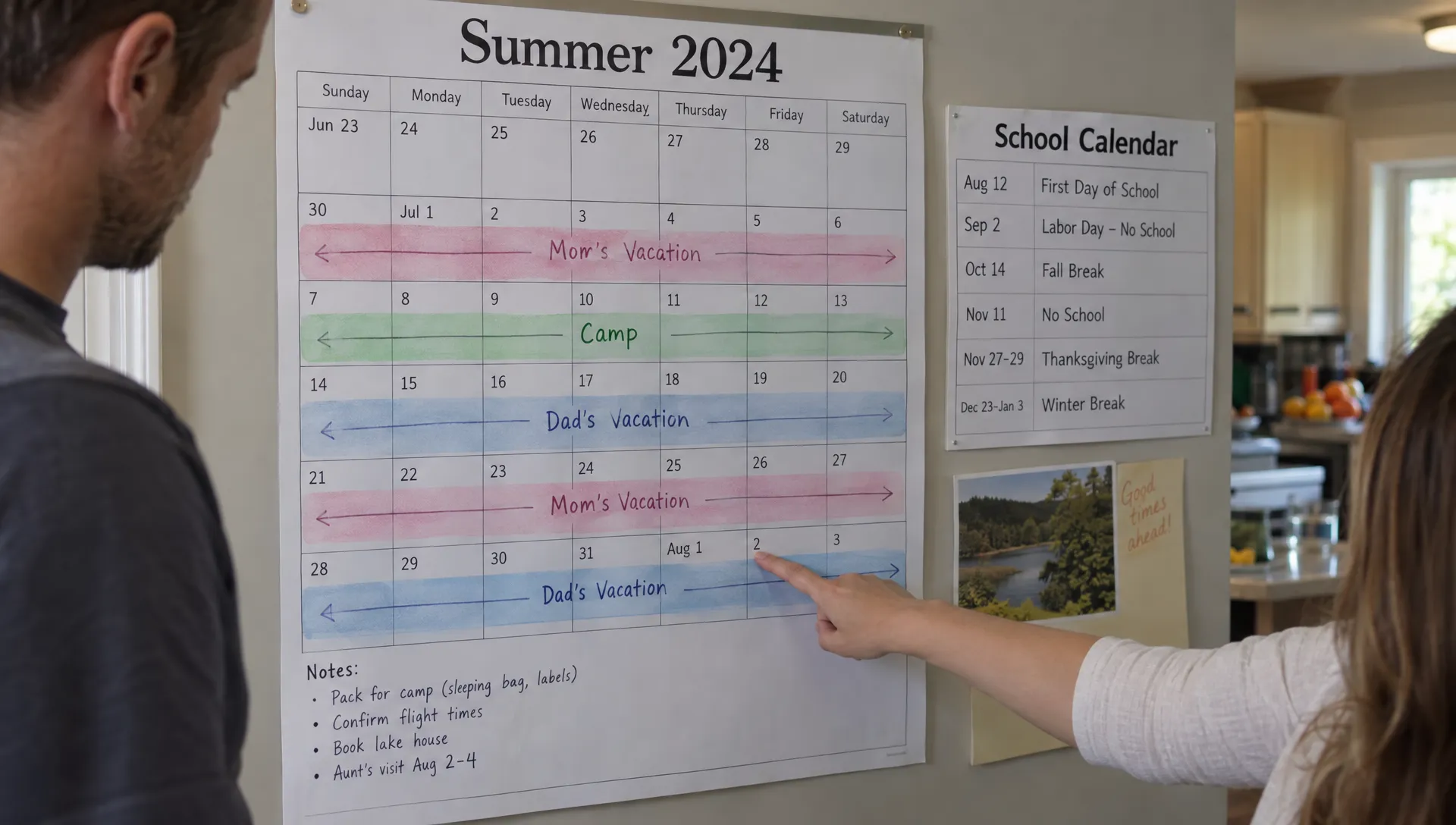
Before entering totals, build a dated summer calendar. Have your parenting order or agreement and the school’s calendar available, along with any confirmed vacation notices.
Record these details:
- Summer boundaries: The exact date and time the summer schedule begins and ends.
- Extended stays: Each parent’s vacation blocks, including pickup and return times.
- Exceptions: Holidays, camps, travel days and any agreed schedule changes.
- Regular visits: Whether weekends or weekday visits continue during extended summer stays.
“Two weeks in July” is not precise enough if the parents disagree about whether the block begins Friday evening or Monday morning. Write down the actual exchanges before counting.
Check which provisions take priority under your order. A holiday may interrupt a vacation block, or a summer provision may replace the usual weekend rotation. Do not assume either rule applies universally. If the language is unclear, resolve that question before treating one interpretation as settled.
If you need a place to organize the inputs, understanding what goes into a parenting time worksheet can help you create a useful record alongside the estimate.
Replace overlapping time instead of adding it
The most common summer calculation mistake is adding every vacation night to an annual total that already includes regular visits on those dates. A parenting time calculator needs one assignment for each counted overnight or time interval, not two overlapping assignments.
Use this reconciliation:
Revised annual time = regular annual time − regular time displaced by summer + replacement summer time.
Suppose a parent receives a 14-night vacation block that includes four nights already assigned to that parent under the regular schedule. The block adds 10 nights to the annual total, not 14, assuming nothing else changes.
An alternative is to build the year from scratch, assigning each night once according to the final schedule. Either method can work. The danger is mixing them, such as adding a summer subtotal to a full-year baseline without subtracting the displaced nights.
Keep the original calendar unchanged and work on a copy. That makes it easier to identify exactly which dates caused the annual percentage to change.
Worked example: a 70-night summer break
Assume a family is planning a 365-day year and uses overnights for this illustration. Their calendar shows:
- Parent A has 104 overnights under the regular year-round schedule.
- The summer period contains 70 overnights, including 20 already assigned to Parent A.
- The replacement summer arrangement gives Parent A 42 overnights and Parent B 28.
The revised annual count for Parent A is:
104 − 20 + 42 = 126 overnights.
Here is the same calculation separated by season:
| Period | Total overnights | Parent A under regular schedule | Parent A after summer changes |
|---|---|---|---|
| Outside summer | 295 | 84 | 84 |
| Summer break | 70 | 20 | 42 |
| Full year | 365 | 104 | 126 |
Parent A’s annual share becomes 126 ÷ 365 × 100 = 34.52%. Parent B has the remaining 239 overnights.
Notice that Parent A has 60% of summer overnights, but only 34.52% of annual overnights. A parenting time calculator should use the relevant full-period total when you are estimating an annual percentage, rather than treating the summer percentage as the year-round arrangement.
This example assumes the 42 summer nights already account for all holidays and exceptions. Any later change requires another reconciliation, not an extra addition to the existing total.
Account for camps, travel and separate schedules
Summer calendars often include nights that are harder to assign than a straightforward stay at either parent’s home.
Day camp usually does not change where a child sleeps, though it may affect an hourly calculation or childcare expenses. Overnight camp, travel with relatives and similar arrangements require closer attention to your order and the applicable counting rules. Do not automatically assign those nights to whoever booked or paid for the activity.
For travel, record when responsibility transfers between parents. A flight’s departure date alone may not tell you which parent receives a particular overnight under the relevant rules.
When siblings have different arrangements, calculate their schedules separately. One child attending sleepaway camp while another remains with a parent can make a single household percentage misleading.
Before finalizing the calendar, flag any unresolved dates rather than silently assigning them. You can compare alternative totals while seeking clarification, but neither scenario becomes legally controlling just because its arithmetic works.
Keep scheduled time and actual visits separate
A proposed schedule, a court-ordered schedule and a record of completed visits answer different questions. Keep separate versions rather than repeatedly overwriting one calendar.
The proposed version helps parents compare options. The ordered version records what the existing order provides. The actual-time log shows what happened, including late exchanges, shortened stays and missed visits.
Which version matters for support depends on state law and the circumstances. For example, Minnesota’s parenting expense adjustment statute addresses scheduled parenting time under a court order and the use of overnights or overnight equivalents. That is a reason to check the governing rule, not to assume every state uses Minnesota’s approach.
When using a parenting time calculator, label the result with its basis, such as “proposed summer schedule” or “actual overnights through August.” A percentage without that explanation can create confusion during negotiations or a support review.
Record missed visits and make-up time by date
If a scheduled seven-night visit ends after five nights, record the two missed nights in the actual-time log. Keep the ordered schedule intact unless it has been changed through the appropriate process.
When make-up time occurs, compare it with the original assignment. A replacement weekend does not necessarily add two annual nights if one of those nights already belonged to the same parent. Count only the actual change from the baseline.
Document the dates, relevant communications and whether the make-up arrangement was agreed to. The treatment of missed time depends on the order and local rules, as explained in this guide to missed parenting visits and make-up time.
Use the annual result in a child support estimate
Once the summer calendar reconciles with the rest of the year, you can use the relevant parenting-time figure in a state-specific support estimate.
Parenting time is only one input. Depending on the state’s guidelines, the calculation may also account for both parents’ incomes, the number of children, eligible health insurance costs and work-related childcare expenses.
Summer camp costs deserve a separate review. Whether a particular camp expense qualifies as childcare, and how that expense should be entered, depends on the applicable rules. Do not assume every summer activity receives the same treatment. If costs must be averaged across the year, follow the worksheet’s instructions rather than entering a large summer bill as a recurring monthly amount.
A parenting time calculator does not establish a custody arrangement or determine the final support obligation. Likewise, a higher summer overnight count does not automatically authorize a parent to reduce an existing payment. Changes to an enforceable order require the applicable modification process.
Check the calendar before relying on the percentage
Do one final date-by-date review before sharing the result. In the two-parent, overnight-based example above, the assigned nights should total 365 for the year. Each counted night should appear once, and the summer subtotal should match the defined summer window.
Confirm that you resumed the correct school-year rotation after summer. Some orders continue an existing alternating pattern, while others specify a restart date or different transition. Follow the actual language rather than assuming the next weekend belongs to whichever parent had less summer time.
Save the inputs with the result. A useful record includes the year, counting method, summer boundaries, exceptions and unresolved assumptions. That gives both parents a way to check the calculation instead of debating an unexplained percentage.
Frequently asked questions
Can I calculate summer parenting time without calculating the whole year? Yes, if you only want the summer split. Divide a parent’s summer time by the total time in that summer period, using consistent units. For an annual estimate, the parenting time calculator also needs the rest of the year accounted for.
Does a two-week summer visit always count as 14 overnights? No. Count the actual overnight stays between the exchange dates under the applicable rule. A visit described casually as “two weeks” may contain a different number, depending on pickup and return times.
Does equal summer time mean equal annual parenting time? No. A 50/50 summer schedule may still produce an unequal annual split if the school-year schedule differs. Calculate each period separately and combine the totals without overlap.
Can I use the result to change my child support payment? Not by itself. The result can help you explore an estimate or prepare for a review, but it does not replace an order or the required modification process. Continue following the existing support order unless it is lawfully changed.
Compare your summer plan with an annual estimate
Once your dates are settled, use Child Support Estimate’s free calculators to explore parenting time and estimated support under simplified state guidelines. Keep the calendar and assumptions beside your result so you can explain what changed.
Start with an accurate parenting time calculator total, then review the state-specific inputs. Treat the result as a planning estimate, not legal advice or permission to change an existing order.