How Parenting Time Guidelines Address Missed Visits and Makeups
Learn how parenting time guidelines handle missed visits, makeup time and denied access, plus what to document before asking a court for help.
Child Support Estimate ·

A canceled weekend, a missed pickup or a denied exchange can leave parents unsure whether replacement time is required. Parenting time guidelines do not create one nationwide rule for missed visits. The answer depends on the applicable state rules, your court order, why the time was missed and what arrangement protects your child’s needs.
The practical starting point is to distinguish a voluntary cancellation from denied access. Then check the controlling documents, record what happened and propose specific replacement dates. Avoid treating missed time as permission to rewrite the schedule yourself. This guide provides general information, not legal advice about a particular order.
Start with the order that governs your family
Locate the signed parenting order and any parenting plan or guidelines incorporated into it. Read the provisions on cancellations, notice, exchanges, transportation and makeup time together. A paragraph about holidays or illness may change how the regular weekend schedule works.
Look for language explaining whether replacement time is required, how quickly it must occur and who chooses the dates. Also check whether schedule changes must be confirmed in writing. If the order is silent, that does not necessarily mean either parent can impose a makeup weekend.
When reviewing parenting time guidelines, use the official state court website rather than an undated schedule copied onto another site. Check the effective date, amendments and whether your order incorporates a particular version. A newer website publication does not, by itself, establish that an older order has changed.
If the family has moved across state lines, do not assume the new state’s sample schedule replaces the existing order. Ask a local family-law attorney or court self-help center which court has authority to address the dispute.
Identify why the visit was missed
The reason matters because a cancellation, an unavoidable interruption and a refusal to comply with an order can call for different responses.
| Situation | What to document | Practical next step |
|---|---|---|
| A parent cancels because of work or travel | Notice given, scheduled dates and proposed alternatives | Check cancellation terms and seek a written adjustment |
| A parent does not arrive | Exchange time, location, messages and how long you waited | Follow any waiting-period provision and request clarification |
| The child is ill | Relevant symptoms, care needs and communications | Check illness provisions and discuss safe alternatives |
| The other parent refuses an ordered exchange | The applicable order, reason given and your response | Consider local enforcement procedures if unresolved |
| Weather or transportation disrupts travel | Cancellations, road conditions and available alternatives | Discuss a safe rescheduling option and transportation costs |
An ordinary inconvenience is not the same as a safety emergency. Likewise, a parent voluntarily giving up a weekend is not necessarily entitled to choose another weekend at the other parent’s expense.
Keep the child out of the dispute. Do not ask them to negotiate dates, deliver accusations or decide which parent is responsible. That communication belongs between adults or their representatives.
How parenting time guidelines differ by state
State-specific provisions can be more detailed than general advice about being flexible. Two examples illustrate why location and the wording of the order matter.
Indiana: consult the provisions on schedule changes
The official Indiana Parenting Time Guidelines address changes in scheduled parenting time, including makeup time. Parents should consult the applicable provisions and any case-specific order rather than assume a missed visit is automatically forfeited or automatically replaceable on any chosen date.
If Indiana’s rules apply, read the complete relevant section. An isolated sentence about makeup time may not explain the accompanying notice, timing or scheduling requirements.
Texas: compensatory time can be a court remedy
Texas Family Code Section 157.168 allows a court to order additional periods of possession or access to compensate for denied court-ordered time, subject to statutory conditions. That is different from allowing a parent to unilaterally take additional days.
These examples show why parenting time guidelines must be read alongside the order and applicable law. A remedy available for denied access in one state may not apply to a voluntary cancellation elsewhere.
Document the missed time without escalating the conflict
Create a factual record while events are fresh. Save the scheduled dates, the relevant order provision, cancellation messages and any written agreement about a replacement. For a missed exchange, note when and where you arrived and what communication occurred.
Describe observable facts rather than motives. “Pickup was scheduled for 6 p.m.; no one arrived by 6:40 p.m.” is more useful than “They never care about their child.” Follow any waiting instructions in the order rather than inventing your own cutoff.
A neutral message might say:
Our order scheduled your parenting time from Friday at 6 p.m. through Sunday at 6 p.m. You told me today that you cannot attend. Please confirm whether you are requesting replacement time and suggest two dates that fit the order and the school calendar.
When parenting time guidelines provide a makeup process, record whether each step was followed. Keep original messages where possible and do not edit screenshots in a way that removes important context.
Avoid covert recordings without checking applicable law. You also do not need to collect unnecessary medical details or involve the child in building evidence against a parent.
Choose replacement time that works for the child
A workable makeup arrangement addresses more than the number of lost hours. Consider school attendance, the child’s age, medication, established activities and the length of time away from either household. For younger children, long separations and abrupt changes deserve particular attention.
For example, if a Friday-to-Sunday weekend is missed, the parents might agree to use an otherwise available weekend of similar length. That is an illustration, not a universal entitlement. The replacement should not displace the other parent’s holiday without authorization or agreement.
Where parenting time guidelines leave room for agreement, confirm the replacement dates, pickup location, transportation duties and return time in writing. Also state whether the change is a one-time adjustment, not a permanent revision of the schedule.
Account for holidays, distance and school calendars
Check the order’s priority rules before selecting dates. A holiday, vacation or school-break provision may override the ordinary weekend rotation. Our guide to accounting for holiday schedules explains how overlapping periods can otherwise be counted twice.
For long-distance families, replacing a short visit with another trip may create disproportionate expense or missed school. Discuss flight availability, travel supervision and responsibility for added costs. A longer block during a school break may be worth proposing, but it must fit the order or receive the necessary agreement or approval.
A video call can help maintain contact during an interruption. Do not assume it replaces in-person time unless the governing arrangement allows that substitution.
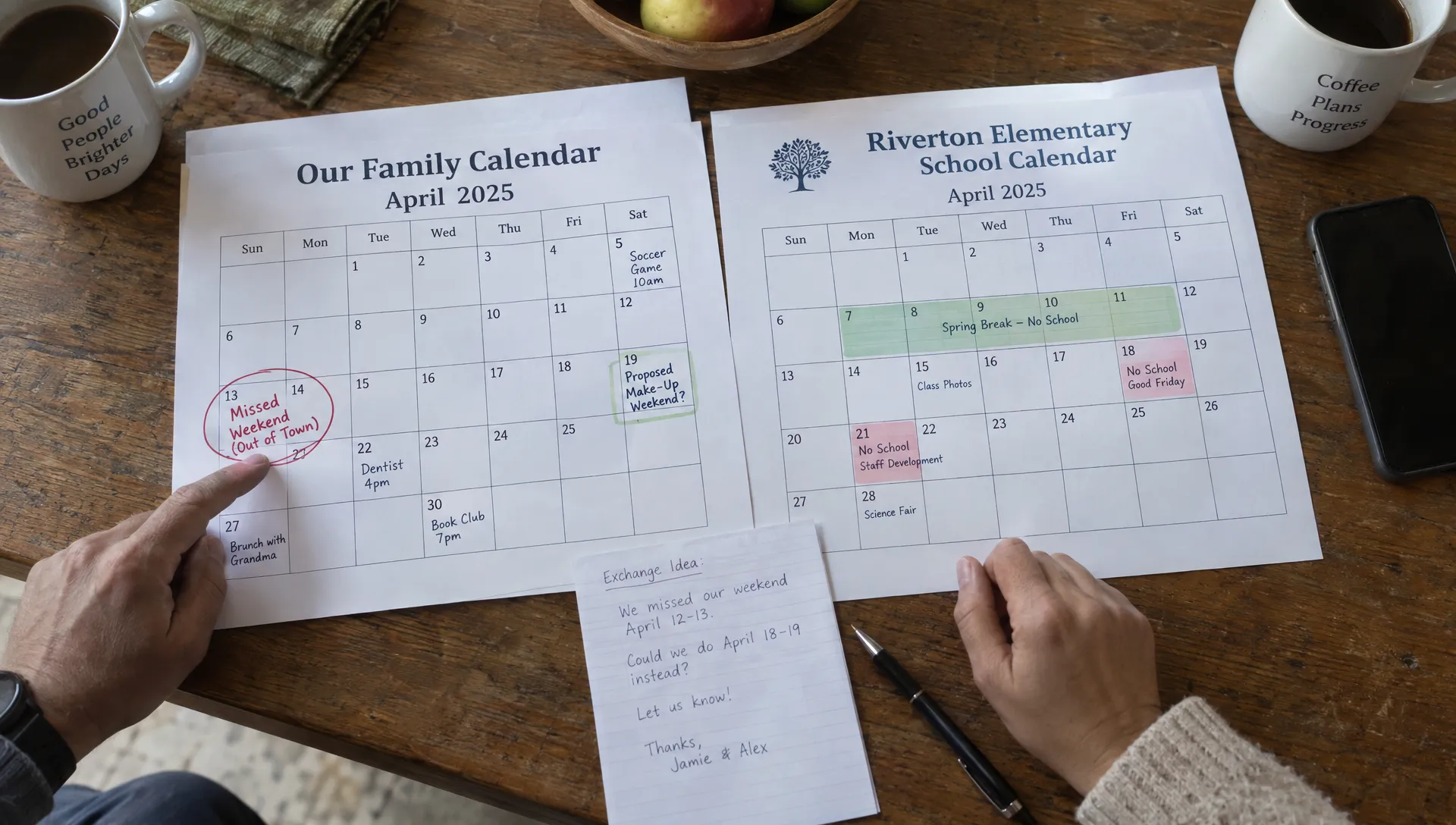
Draft a clear proposal rather than a unilateral demand
A proposed provision for discussion with a lawyer, mediator or the other parent could read:
A parent who expects to miss scheduled time will notify the other parent as soon as reasonably possible. Any makeup time will be arranged in writing, subject to the existing order and the child’s school and health needs. The agreement will identify dates, exchange times and transportation responsibilities. If the parents cannot agree, neither will change the ordered schedule unilaterally, and they will use the applicable dispute-resolution or court process.
This is a discussion example, not a complete legal clause. If parenting time guidelines or the existing order specify notice periods or makeup deadlines, a proposal should account for those requirements. A private message exchange may document agreement without formally modifying the underlying order.
Respond to repeated no-shows or denied visits
One disrupted exchange and a recurring pattern are different problems. Repeated cancellations can make childcare, work schedules and the child’s expectations difficult to manage. Repeated denials may require an enforcement response rather than endless informal negotiations.
Begin with a concise written request identifying the problem and the relief sought. If direct resolution fails, available options may include court self-help services, an enforcement motion or a request to modify an unworkable schedule. Mediation may be appropriate when it is safe and permitted or required locally.
Parenting time guidelines may help identify the expected conduct, but they do not guarantee a particular enforcement outcome. Courts consider the order’s clarity, the facts and applicable legal standards. Contempt and other remedies are not automatic consequences of every missed visit.
When a parent repeatedly chooses not to attend, obtaining a schedule that reflects reality may be more useful than relying on enforcement to produce meaningful involvement. Do not assume repeated nonattendance automatically terminates that parent’s rights.
Handle illness, reluctance and safety concerns carefully
Illness does not always require cancellation. A child with a minor illness may still receive appropriate care in either home, while a serious condition may make travel unsuitable. Consult the order, share necessary care instructions and seek medical guidance when appropriate.
A child’s reluctance also needs context. Age, transitions, conflict and possible mistreatment can all affect behavior. Avoid placing the decision entirely on the child or using physical force as a scheduling solution. Seek legal guidance and, where appropriate, qualified child-focused support.
If there is an immediate danger, contact emergency services. For suspected abuse, threats or unsafe exchanges, seek prompt advice about protective orders, emergency custody relief or supervised exchanges. Do not assume an informal agreement or a general makeup provision adequately addresses safety. At the same time, a safety concern does not automatically resolve the legal consequences of withholding time; obtain guidance promptly.
Keep child support separate from makeup disputes
Missed parenting time does not automatically reduce child support, and unpaid support generally does not authorize withholding court-ordered access. Do not deduct travel expenses, missed weekends or disputed costs from payments unless an applicable order or law authorizes it.
Although parenting time guidelines address scheduling, a sustained change in the actual care arrangement can also raise a separate support question. States differ in whether and how they consider ordered time, exercised time or other parenting-time measures. A single missed overnight is not a universal recalculation trigger.
Keep separate records of the ordered schedule and what actually occurred. If the arrangement has changed substantially, review when child support may be modified and ask about the proper filing process. Do not assume a later adjustment will erase amounts already due.
Frequently asked questions
Does every missed visit require makeup time? No. The answer depends on the order, applicable law and why the visit was missed. Voluntary cancellations and denied access may receive different treatment.
Can I choose a replacement weekend without permission? Do not assume so. Parenting time guidelines or an order may establish a selection process, but otherwise you may need agreement or court relief. Taking extra time unilaterally can create another violation.
How long should I wait when the other parent is late? Check the order and applicable local rules. There is no nationwide waiting period. Record your arrival and communications, and prioritize a safe arrangement for the child.
Does a makeup visit change the permanent schedule? Not necessarily. Confirm that a one-time agreement is temporary. A lasting change may require a formal modification, and requirements vary by jurisdiction.
Estimate support separately from resolving the schedule
If a lasting parenting-time change raises financial questions, Child Support Estimate offers free estimates using simplified state guidelines, with inputs for income, parenting time and expenses. Use the result for planning, not as permission to change payments or as a substitute for legal advice.