How to Use a Custody Calculator to Account for Holiday Schedules
Use a custody calculator to count holiday schedules, split school breaks and avoid double-counting parenting time before estimating child support.
Child Support Estimate ·

Holiday parenting time rarely fits neatly into a repeating weekly schedule. Thanksgiving may replace a regular weekend, winter break may cross into January and a holiday visit may include several hours but no overnight. A custody calculator is most useful when you treat those events as changes to your regular schedule, not extra time to add automatically.
The practical approach is to build the regular calendar, apply the holiday rules in your parenting plan and count each time period only once. Then use the measurement your state and calculator require, whether that is overnights, hours or another defined method.
Start with the right calendar and documents
Before entering numbers, gather your current parenting order or agreement, the relevant school calendar and the regular exchange schedule. Include amendments that change holiday arrangements or transportation responsibilities.
Identify the period you are calculating. A calendar-year estimate for 2026 covers January 1 through December 31, with 365 possible overnights. A school-year calculation covers different dates. Do not mix the two or assume a repeating two-week schedule captures every date correctly.
Also distinguish physical parenting time from legal custody, which generally concerns decision-making authority. A percentage does not establish either parent's legal rights.
Look for provisions addressing holiday priority, odd- and even-year assignments, exchange times, summer vacations and the return to the regular rotation. Our guide to what parenting guidelines cover and when they apply explains why a general guideline and your particular order may have different roles.
Before using a custody calculator, confirm which schedule and counting method belong in the estimate. If the order is unclear, flag the ambiguity rather than silently choosing the interpretation that produces a preferred percentage.
Apply holidays as replacements, not automatic additions
A holiday schedule often overrides the ordinary weekly schedule, but your order determines the priority. Do not assume that every holiday outranks every vacation or that a parent's birthday takes precedence over a school break.
For each holiday, identify the parent who would have the child under the regular schedule and the parent assigned that time under the holiday provision. Only the difference changes the annual total.
Suppose Parent A already has Friday and Saturday nights. Their Thanksgiving period runs from Wednesday evening through Sunday evening, covering four overnights. Parent A gains two nights, not four, because Friday and Saturday were already included in the baseline.
If the holiday instead belongs to Parent B, remove any overlapping nights from Parent A's total. Apply the transfer to both parents' records so the same night does not appear in both columns.
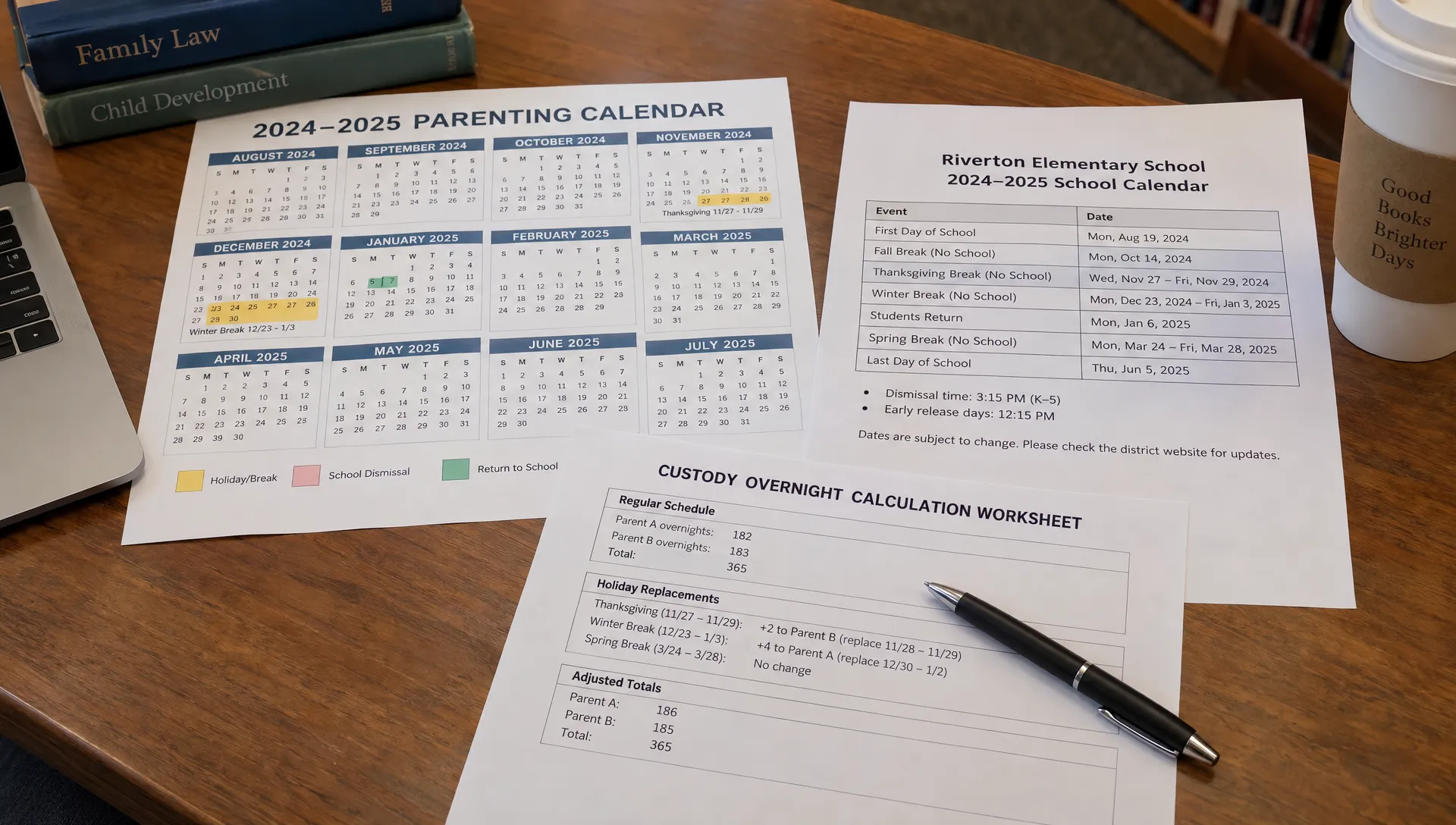
A simple worksheet can record the holiday's start and end, regular assignment, holiday assignment and net change. Keep a note identifying the provision you followed. This makes a custody calculator result easier to check and helps distinguish a counting mistake from a genuine disagreement about the schedule.
Record exact exchange times for split holidays
Partial days and same-day visits
“Thanksgiving with Dad” is not precise enough to count. Record the actual start and end times specified in the plan.
For example, a visit from 10 a.m. to 8 p.m. on Thanksgiving is 10 hours but includes no overnight. Under a simple overnight-counting method, it adds no overnight to that parent's total. A method based on hours or a state-defined parenting day may treat it differently.
By contrast, Wednesday, November 25, 2026, at 6 p.m. through Sunday, November 29, at 6 p.m. includes four overnights: Wednesday, Thursday, Friday and Saturday.
Do not convert a daytime visit into a fractional overnight unless the applicable instructions specifically allow it. Entering 0.5 because a visit “feels like half a day” can introduce a measurement the formula does not use.
School dismissal, travel and delayed exchanges
If a break begins “at school dismissal,” use the relevant school's calendar rather than a generic holiday date. Check whether the return is Sunday evening, Monday morning or the first day school resumes.
A flight delay or one-time exchange change may also make actual time differ from ordered time. Record that separately instead of rewriting the underlying holiday provision. Your custody calculator inputs should clearly represent either the ordered schedule or the actual schedule, depending on the purpose and applicable rules.
Handle winter break across two calendar years
Winter break requires particular care because one continuous visit can belong to two annual calculations.
Suppose a parent has the child from December 28 at 6 p.m. until January 3 at 6 p.m. Under a straightforward overnight tally, that includes six nights. If you are counting calendar-year overnights by the date each night begins, four fall in December and two fall in January. Follow any different convention required by the relevant worksheet.
Do not put all six nights into December's year merely because the visit began then. Likewise, avoid counting the January nights again when entering the following year's holiday schedule.
Odd- and even-year provisions need their own check. An order might assign the first half of winter break according to the year in which the break begins, or define Christmas and New Year's separately. Use its actual wording.
Calculate each year separately when holiday assignments alternate. Average two years only when the applicable guidelines or worksheet call for that approach. For an ordinary calendar-year overnight percentage, use 365 nights for 2026 and 366 for a leap year such as 2028.
Check your custody calculator with a net-change example
The following example is illustrative, not a recommended schedule or a state child-support formula. Assume Parent A has 104 overnights on a fully counted regular calendar before holiday exceptions. Each holiday block below falls within the selected year and does not overlap another listed block.
| Holiday block | Nights in the block | Parent A's regular nights | Parent A's holiday nights | Net change for Parent A |
|---|---|---|---|---|
| Thanksgiving | 4 | 2 | 4 | +2 |
| Winter break portion | 6 | 2 | 6 | +4 |
| Spring break portion | 4 | 2 | 0 | -2 |
The adjusted total is 104 + 2 + 4 - 2 = 108 overnights. For a 365-night year, that is approximately 29.6% of annual overnights. The other parent has 257 nights, assuming every night is assigned to one parent under this simplified method.
Notice that the holiday blocks contain 14 nights, but Parent A's annual total rises by only four. Adding all assigned holiday nights without removing the regular assignments would overstate the result.
For a refresher on the underlying annual count, our guide to calculating custody percentages from overnights covers the baseline process.
Enter the adjusted result using the tool's required units
If a tool accepts individual schedule exceptions, enter the holiday dates and check whether they replace the regular schedule. Do not assume every tool handles overlaps automatically.
If it accepts only annual overnights or a percentage, finish the holiday worksheet first. Enter 108 nights or approximately 29.6% in the example above, according to the field's instructions. Do not enter “29.6” into a field asking for nights.
Check whether the tool asks for one parent's time, both parents' time or an average across a specified period. For children with different schedules, calculate each child's time separately and follow the tool's instructions for multiple children rather than inventing a blended percentage.
Keep the underlying count even if the displayed result is rounded. A custody calculator showing 30% may be rounding 29.6%, which is not necessarily the same input as exactly 30% under a state worksheet.
Use the percentage carefully when estimating support
Parenting-time percentages do not translate into one nationwide child-support adjustment. States differ in their definitions, formulas and treatment of shared parenting.
For example, California Courts explains that child support depends on factors including income and time with the children. That does not mean another state uses California's method or counts a holiday visit the same way.
Before relying on a support estimate, check the current official state court or child-support agency instructions for the required time measure, applicable calculation period and treatment of eligible expenses. Enter income, health coverage and childcare information consistently when comparing holiday scenarios.
A custody calculator can help organize the parenting-time input, but it cannot determine whether a legal threshold applies to your case. More parenting time does not guarantee a particular reduction, and equal time does not automatically eliminate support.
Keep ordered time and actual time separate
When parents regularly follow a different schedule from their order, maintain two clearly labeled records: ordered parenting time and actual parenting time.
For example, if the order assigns Christmas week to Parent A but the child stays with Parent B, record the actual dates and any written agreement about the change. Do not describe that year's actual arrangement as a permanent amendment unless it has become one through the appropriate process.
Which record belongs in a legal support calculation depends on state law and the facts of the case. A one-time accommodation and a sustained change may be treated differently.
When comparing scenarios in a custody calculator, preserve the assumptions behind each result. An estimate does not modify an order, authorize withholding parenting time or permit a parent to change an existing support payment. Ask a qualified family-law attorney or court self-help center how to address a continuing mismatch.
Check privacy and accessibility before entering family details
For a preliminary worksheet, use labels such as Parent A and Parent B instead of children's names. Avoid entering birth dates, addresses, case numbers or school details unless a specific service requires them for a clearly explained purpose.
Review the tool's privacy policy before submitting information. Check whether inputs are stored, shared or used for follow-up contact. Do not assume that a custody calculator saves nothing simply because it does not require an account. If you request attorney review, check what information that separate request shares.
If a visual calendar is difficult to use, maintain a plain-text date log or accessible spreadsheet. The important information is the exchange interval and assigned parent, not the color used to mark the holiday.
Frequently Asked Questions
Do holiday overnights count toward parenting time? They generally belong in an annual overnight tally when they fall within the calculation period. Replace any overlapping regular assignments rather than counting both. The applicable state instructions determine how parenting time is used for support.
What if a holiday falls on my regular weekend? Count the time once. If the holiday leaves the child with the same parent for the same nights, there may be no change to the annual overnight total. A longer holiday period may add nights outside the usual weekend.
Can a custody calculator decide who gets Christmas? No. It can help quantify a proposed or existing arrangement, but the parenting order, applicable rules and legally effective agreements determine the schedule. It does not resolve conflicting interpretations.
Does the regular weekend rotation restart after a holiday? Follow the plan's language. Some schedules resume the original rotation, while others specify a different arrangement. Do not automatically restart the rotation or create make-up time unless the governing terms provide for it.
Turn the holiday calendar into a planning estimate
Once you have checked holiday priorities, removed overlaps and confirmed the required units, use Child Support Estimate's free state-specific calculators to explore how the adjusted parenting-time input may affect estimated support alongside income and eligible expenses.
Keep your worksheet with the result so you can explain what changed. A custody calculator provides a planning estimate, not a custody decision, a modified order or legal advice.