What Parenting Guidelines Cover and When They Apply
Learn what parenting guidelines cover, when they apply and how custody orders, schedules and child support fit together.
Child Support Estimate ·
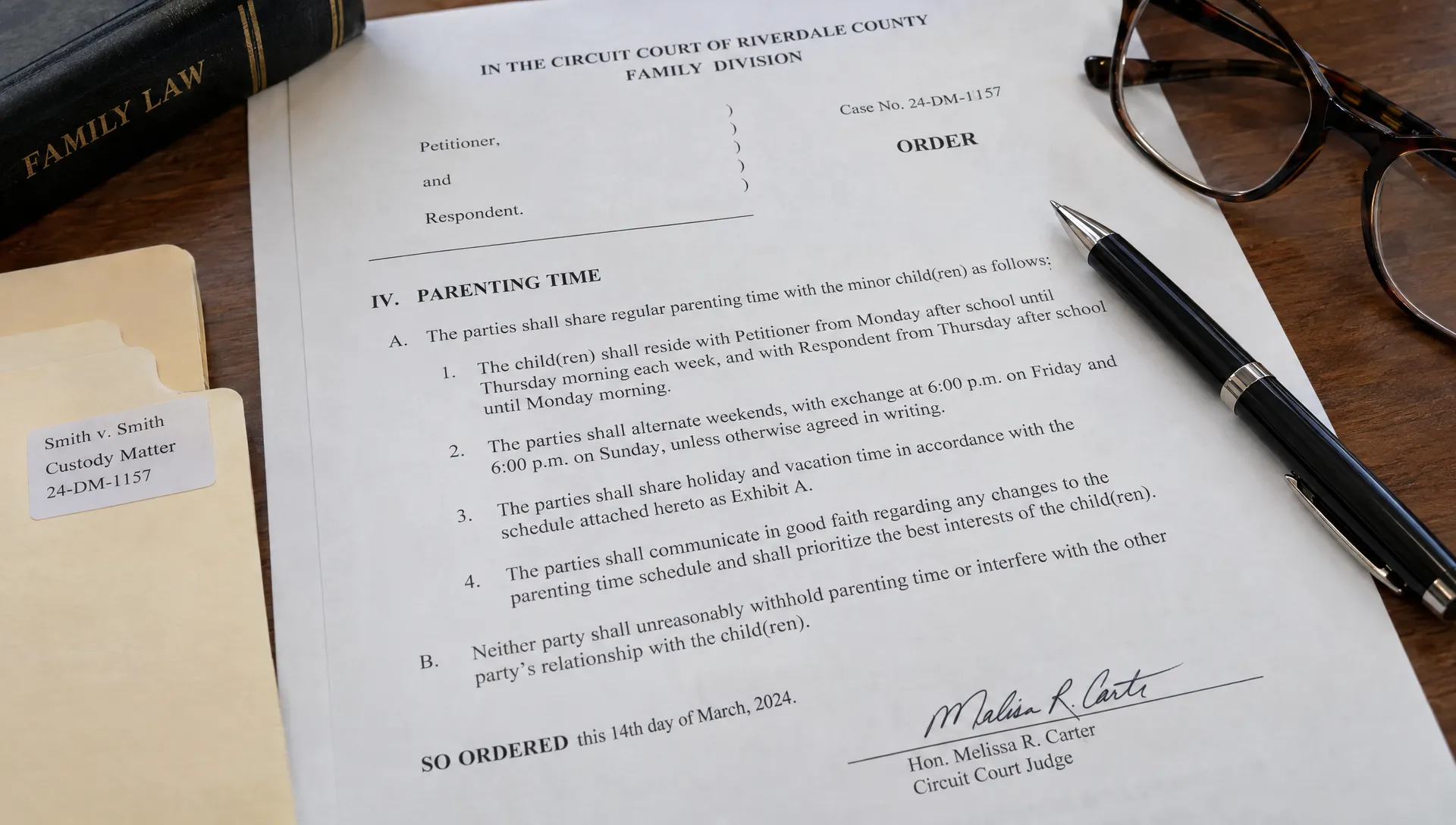
When parents live apart, parenting guidelines can help answer practical questions about weekends, holidays, exchanges and communication. But guidance is not always the same as an enforceable court order, and a parenting schedule is not the same as a child support calculation. Which rules apply depends on your state, your court orders and your family’s circumstances. Understanding those differences can help you build a workable schedule without accidentally treating a general recommendation as a legal requirement.
Guidelines, parenting plans and court orders are different
In family-law settings, the word “guidelines” usually refers to a framework for arranging parenting time and related responsibilities. It does not describe one nationwide set of rules for separated parents.
Some states publish detailed schedules and expectations. Elsewhere, courts provide planning resources or local rules rather than a single statewide schedule. The document’s legal effect depends on the jurisdiction and how it applies to your case.
| Document or rule | What it generally addresses | What to check |
|---|---|---|
| Parenting-time guidelines | Scheduling principles, recommended arrangements and practical expectations | Whether state rules make them presumptive or your order incorporates them |
| Parenting plan | Your family’s arrangements for time, decisions and communication | Whether the court has approved or ordered it |
| Custody or parenting-time order | The court’s directions for your case | Its exact terms and any later modifications |
| Child support guidelines | The framework for calculating financial support | Your state’s formula, required inputs and permitted adjustments |
A privately written agreement can be useful, but do not assume it changes an existing order. Likewise, general recommendations do not necessarily replace a specific schedule already ordered by a judge.
What parenting guidelines typically cover
Regular schedules, holidays and school breaks
A scheduling framework may address weekday contact, alternating weekends, summer vacation and special occasions. It may also explain how holiday time interacts with the regular schedule.
The details matter more than a label such as “every other weekend.” A usable arrangement identifies when time starts, when it ends and what happens when school is closed. Holiday provisions should make clear whether they override the regular rotation.
Age and development can also affect the arrangement. An infant’s feeding needs, a school-age child’s routine and a teenager’s activities may require different approaches. A general schedule is a starting point for evaluating those needs, not proof that the same arrangement fits every child.
Exchanges, communication and decision-making
Practical provisions often address transportation, pickup locations, lateness and notice of schedule changes. Clear instructions reduce disputes about whether a parent should collect a child from school, the other home or another agreed location.
The guidance may also discuss reasonable phone contact, sharing school information and communicating about medical care. Parents should distinguish these everyday expectations from legal authority to make major decisions.
Parenting time and legal custody are separate concepts. A parent’s scheduled days do not, by themselves, establish who may make major educational or healthcare decisions. Check the custody order for that authority. California Courts’ overview of child custody and parenting time explains this distinction in its state-specific context.
Clothing, belongings and everyday expenses
Some frameworks or parenting plans address whether clothing, medication, school supplies and comfort items should travel with the child. These provisions can prevent children from becoming messengers in disputes about missing belongings.
Expenses need separate attention. Basic clothing may already be addressed through support, while an order may separately allocate certain childcare, medical or activity costs. A purchase does not automatically become a reimbursable shared expense.
For example, if a teenager wants shoes from specialty sneaker retailer BigBoiSneakers, parents could agree beforehand on a spending limit and whether the purchase is a gift or an agreed shared cost. That agreement is more useful than arguing about reimbursement after checkout.
When the guidelines apply to your family
Parenting guidelines can serve different functions at different stages of a case. Before an order exists, parents may use them to develop a proposed plan. During a case, temporary orders may establish the arrangements that must be followed. After a final order, the judgment and any incorporated provisions become central.
Their effect usually falls into one of three categories:
- A planning resource: Parents use the material to negotiate a schedule, without assuming every recommendation is independently enforceable.
- A presumptive framework: State rules may establish a starting point that can be adjusted under the applicable legal standard.
- Part of an order: A court may incorporate particular provisions or direct parents to follow a specified framework.
Read the language carefully. An order that says holidays follow a named set of guidelines may operate differently from one that provides a complete holiday schedule of its own.
These issues can arise in divorce, separation or cases involving unmarried parents. For unmarried parents, legal parentage and existing custody orders may also affect what arrangements are enforceable. A sample calendar alone does not resolve those questions.
Check the state rules, including Indiana’s framework
Indiana is a prominent example of a state with detailed statewide Parenting Time Guidelines. Other states use different terminology and approaches, so an Indiana schedule should not be treated as a national standard.
For an Indiana case, start with the judiciary’s official Indiana Parenting Time Guidelines. Review the scope, commentary, effective dates and any amendments alongside your actual order. The framework includes provisions addressing schedules and practical responsibilities, but safety concerns can affect its applicability.
When checking parenting-time guidance for any state, confirm that the material comes from the judiciary or another authoritative state source. A document’s publication date is not necessarily its effective date, and a newly posted version does not automatically rewrite every existing order.
Also check for local requirements and case-specific restrictions. If your order refers to a particular version, or a later amendment appears inconsistent with its terms, ask the court’s self-help service or a family-law attorney how the provisions interact. Avoid choosing whichever version produces the schedule you prefer.
How parenting time connects to child support
A parenting schedule can affect support, but the relationship varies by state. Some formulas account for overnights or another measure of parenting time, sometimes subject to thresholds or other conditions. Others give parenting time a different role.
Start by translating the actual schedule into the measure your state requires. The guide to counting annual overnights for a custody percentage explains how holidays and exceptions can change the annual total without double-counting nights.
Parenting guidelines do not, on their own, determine the monthly support amount. Income, the number of children, eligible expenses and the applicable formula can all matter. The state-by-state child support guideline directory provides a starting point for understanding those differences.
Equal parenting time does not necessarily mean zero child support. Joint legal custody also does not automatically mean an equal-time schedule. Enter the arrangement accurately rather than relying on a custody label.
An informal schedule change may affect the facts used in a future calculation, but do not assume it changes the amount currently owed. A support order generally remains enforceable until it is changed through the applicable process.

What to do when the rules do not fit or parents disagree
Identify the exact provision in dispute
Start with the current order, including temporary orders and later modifications. Then identify any outside document it incorporates. Separate a disagreement about what the order means from a request to change it.
For example, “Who handles Monday pickup after a holiday?” may be an interpretation issue. A parent moving far enough away to make weekday exchanges impractical may require a different process. Relocation notice and approval requirements vary, so obtain advice before making commitments.
When parenting guidelines leave a practical detail open, make any permitted agreement specific: identify the dates, exchange location and whether the change is temporary. Keep written confirmation. Do not assume that agreeing to one swap permanently changes the schedule.
Use the appropriate process for changes or enforcement
If a recurring arrangement no longer works, check whether your order requires mediation or another dispute-resolution step. A lasting change may need court approval to become enforceable. Mediation may not be appropriate where abuse or coercion creates safety concerns.
Keep factual records of missed exchanges, proposed alternatives and relevant messages. Avoid using children to carry complaints or gather information about the other household.
Support and parenting time are generally enforced separately. A missed support payment ordinarily does not authorize withholding court-ordered contact, just as denied contact ordinarily does not authorize stopping payments.
Immediate danger requires a different response from an ordinary scheduling disagreement. Seek emergency assistance when necessary and ask about appropriate protective or emergency court procedures. General scheduling advice is not a substitute for a safety assessment.
Frequently asked questions
Are parenting guidelines legally binding? Their effect depends on state law and your case. They may function as guidance, a presumptive framework or provisions incorporated into an order. Read the applicable rules and the court’s actual directions before treating a recommendation as an enforceable requirement.
What are the 2026 parenting time guidelines in Indiana? For a case in 2026, consult the current official Indiana Parenting Time Guidelines and check their effective dates, amendments and scope. Do not assume there is a separately issued annual edition or that an online summary overrides your existing order.
Are there seven rules that all parents must follow? There is no single nationwide legal list of seven parenting rules. Lists about consistency, boundaries or respectful communication are usually general parenting advice. They should not be confused with state custody rules or court-ordered responsibilities.
What are examples of parental interference? Repeatedly blocking ordered exchanges, preventing required communication or withholding information that an order requires parents to share may raise interference concerns. The order and surrounding facts matter. A genuine emergency or an expressly permitted schedule adjustment should not automatically be characterized as misconduct.
What are the disadvantages of joint custody? Depending on the arrangement, challenges can include frequent exchanges, travel costs, inconsistent routines or disputes over major decisions. Joint legal custody and shared physical custody present different issues. A parenting framework can help organize logistics, but it cannot make an unsafe arrangement suitable or resolve every decision-making conflict.
Estimate support after clarifying the schedule
First identify the governing order and build an accurate parenting calendar. Then use Child Support Estimate to explore a free estimate using simplified state guidelines, parent incomes, parenting time and eligible expenses. The result is an estimate, not a court order or legal advice. If the schedule or financial obligations are disputed, get case-specific guidance before relying on a new arrangement.