What Is a Parenting Time Worksheet and What Goes Into It?
Learn what a parenting time worksheet includes, how to fill it out and how to check schedules and overnight totals before estimating child support.
Child Support Estimate ·

A parenting time worksheet is a planning document that helps you organize when a child will be with each parent, including the regular schedule, holidays, vacations and exchanges. Depending on its purpose, it may also help calculate each parent’s share of parenting time for a child support estimate. The name does not refer to one nationwide form: a court worksheet, a mediator’s planning sheet and a personal calendar may serve different purposes.
The most useful worksheet turns broad intentions into specific arrangements that parents can follow and, when needed, check against local court requirements.
How a worksheet differs from a parenting plan and custody order
A worksheet is generally a working document. It gathers information, exposes scheduling conflicts and helps you prepare a proposed arrangement. A parenting plan sets out the arrangements themselves, often covering both the schedule and other parenting responsibilities. A court order establishes legally enforceable requirements. A completed worksheet does not automatically become an order or change an existing one.
It also helps to separate parenting time from legal custody. Parenting time generally concerns when a child is in each parent’s care. Legal custody generally concerns authority to make significant decisions, such as those involving education or healthcare. Terminology varies by state, but sharing decision-making does not necessarily mean dividing time equally.
California Courts’ child custody guidance explains these distinctions within California’s system. Your own jurisdiction’s definitions and forms control your case.
For practical purposes, identify what you are preparing before entering dates: a proposal for discussion, a record of time actually exercised or information for a required court or support calculation. Those documents should not be treated as interchangeable.
What goes into a parenting time worksheet?
A useful worksheet captures enough detail to reconstruct the schedule without guessing. It should identify the child, the planning period and whether the entries reflect a proposal, an existing order or actual events.
The recurring schedule
Record which parent has each overnight or block of time, along with precise start and end times. “Alternating weekends” is incomplete without a starting date and a definition of the weekend. Friday school dismissal through Monday school drop-off differs from Friday evening through Sunday evening.
Include school-day arrangements, midweek visits and any separate summer pattern. If siblings follow different schedules, use separate entries or calendars rather than assigning one household percentage to every child.
Holidays, breaks and exceptions
List holidays, school breaks, birthdays and vacation periods separately from the recurring schedule. Specify the applicable year, start and end times and which schedule takes priority when periods overlap.
For example, a holiday arrangement might replace the regular weekend rather than extend it. Record that rule explicitly. Otherwise, the same overnight could appear in both parents’ totals.
Exchanges and communication
Record exchange locations, transportation responsibilities and how parents will communicate about delays or requested changes. Include any applicable notice deadlines and arrangements for a child’s contact with the other parent.
A parenting time worksheet should make these details visible rather than leave them to assumptions. Where safety restrictions or supervised exchanges apply, follow the order and obtain appropriate legal guidance instead of relying on a generic cooperative-parenting template.
How to find the correct local form
Start with the official website for your state judiciary or the court handling your case. Look under family law, custody, parenting plans or self-help forms. Check whether the instructions are statewide or specific to a county or judicial district.
The title may not contain the word “worksheet.” Relevant materials might be called a parenting plan, residential schedule, time-sharing schedule or custody attachment. A support worksheet may ask only for a parenting-time figure and require a separate document to explain the schedule.
Before completing a parenting time worksheet, confirm whether it is required, optional or intended only for private planning. Read the instructions for signatures, attachments, filing and service. A court clerk or self-help center can help identify available forms and procedures, though they generally cannot advise you on which arrangement to request.
For an example of court-provided resources, the Oregon Judicial Department’s parenting-plan page offers planning materials. Use resources from another state for ideas, not as substitutes for your court’s required forms.
How to complete the worksheet
Set the purpose and date range
Label the document clearly: “proposed schedule,” “current ordered schedule” or “actual parenting-time record.” Add a preparation date so different versions do not get confused.
Choose a defined planning period. A full calendar year can reveal holiday and vacation effects that a two-week sample misses. A school-year period may be useful for logistics, but a support calculation could require a different period or counting method.
When completing your parenting time worksheet, keep the ordered schedule separate from what actually happened. If both matter, use separate columns or documents rather than silently replacing one with the other.
Enter the regular pattern first
Begin with the repeating schedule and a specific start date. Assign each day or overnight according to the agreed or ordered arrangement before adding exceptions.
Translate vague descriptions into concrete entries. Instead of “Parent B gets every other weekend,” write the first applicable Friday, the pickup time and the return time. If exchanges occur at school, explain what happens when school is closed.
Check the pattern against work hours, school attendance and travel time. A calendar that looks balanced may still require an impractical weekday commute.
Add exceptions in a clear order
Next, enter holidays, school breaks and vacations using the priority rules in the order or proposed plan. If no rule exists yet, flag the conflict for resolution rather than assigning it arbitrarily.
For each exception, identify the regular time it replaces. Our guide to accounting for holiday schedules in parenting-time calculations explains why replacement matters when checking annual totals.
A parenting time worksheet should also distinguish a requested change from an accepted change. Record the request date, response and resulting arrangement where appropriate. Do not assume an unanswered request modifies an existing order.
Check logistics and unresolved questions
Review exchanges as actual trips: who travels, where the child waits and what happens if an activity ends late. Consider medication, school materials and other items the child needs between homes.
Mark unresolved issues plainly. For example, “summer vacation notice deadline unresolved” is more useful than a blank field that could be mistaken for agreement.
For missed visits, keep a factual record without assuming makeup time is automatic. The applicable order and local rules matter, as explained in our guide to missed parenting time and makeup arrangements.
A copyable planning template
You can copy this table into a document or spreadsheet, expand the cells and print it. It is an informal organizer, not an official court form. Keep sensitive identifiers out of shared drafts unless a required form specifically asks for them.
| Field | Information to enter |
|---|---|
| Purpose and version | Proposed, ordered or actual schedule; preparation date |
| Child and planning period | Child identifier appropriate for the document; start and end dates |
| Governing documents | Relevant order date and schedule provisions, if any |
| Regular school-week schedule | Parent responsible for each period; exact exchange times |
| Weekend rotation | Starting date, repeating pattern and return time |
| Summer schedule | Whether the regular pattern continues or changes |
| Holidays and school breaks | Assignments, dates, times and any odd/even-year rotation |
| Vacations and special dates | Permitted periods, notice requirements and birthdays |
| Priority rules | Which arrangement controls when schedules overlap |
| Exchanges and transportation | Locations, pickup responsibilities and closure-day alternatives |
| Communication and changes | Contact method, notice process and how changes are documented |
| Counting method and totals | Overnights, hours or other required units; totals for each child |
| Open issues | Conflicts, missing information and questions for review |
For an editable version, preserve the original template and save each revision separately. For a printable version, check that dates and exchange times remain visible across page breaks. Add a calendar attachment when the table alone cannot show a complicated rotation.
Before sharing a parenting time worksheet, remove private notes that are not needed for its purpose. Keep any separate supporting records securely stored.
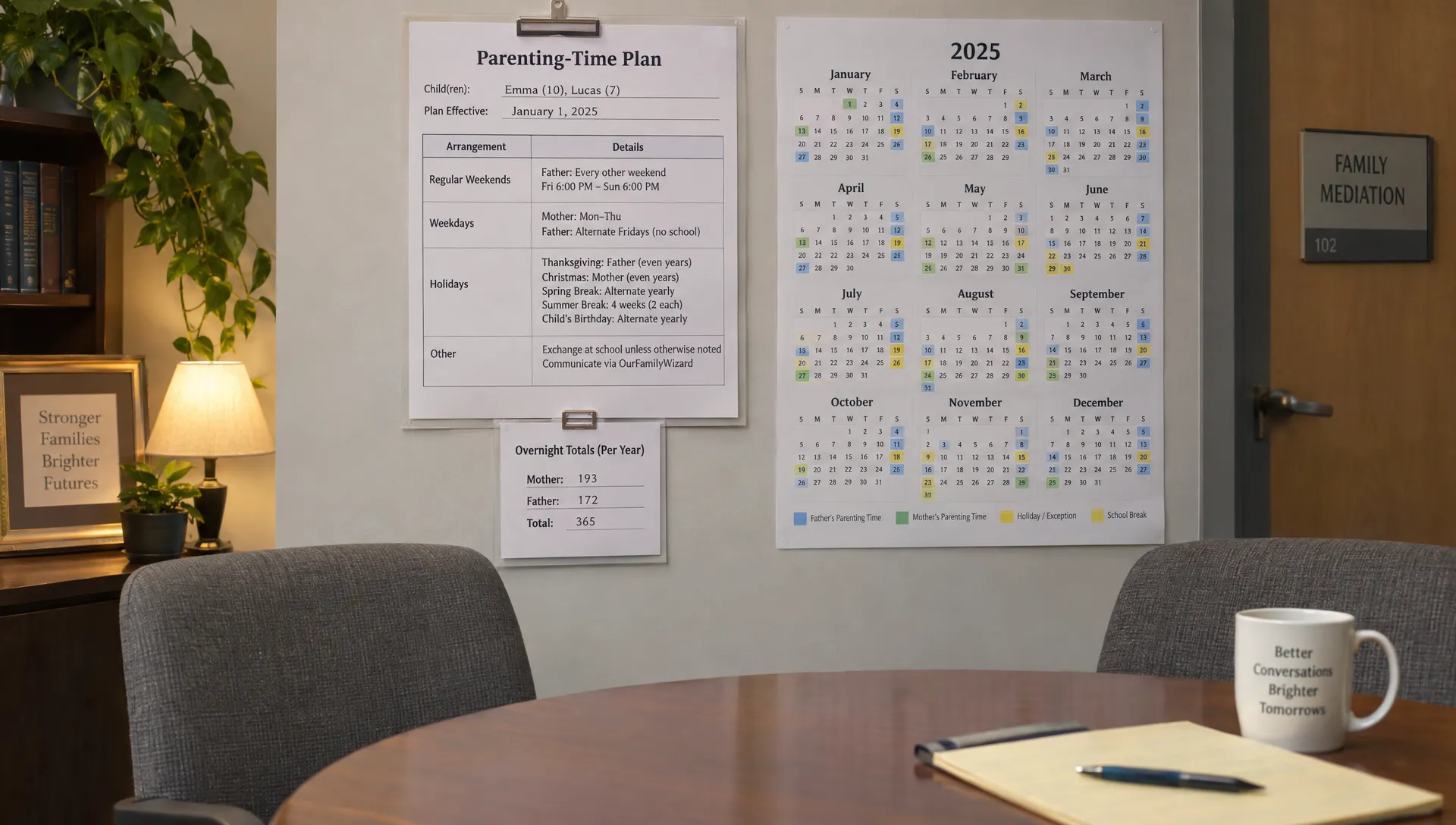
How to verify the parenting-time totals
First, confirm the counting unit required for your purpose. Some calculations use overnights, while others use hours or state-defined measures. Do not assume that a daytime visit counts as an overnight or that your personal calendar’s percentage matches the child support guidelines.
For a simple overnight example, suppose a child’s baseline schedule assigns Parent B 140 nights in a 365-night year. Holiday and vacation replacements add nine nights to Parent B’s allocation and remove three:
140 + 9 − 3 = 146 overnights.
Parent A has the remaining 219 nights. Parent B’s share is 146 ÷ 365 × 100 = 40%, and Parent A’s share is 60%. This is illustrative arithmetic, not a state-specific support rule.
Check that every overnight is assigned once, that totals cover the chosen period and that leap years use the correct denominator. Verify year-end boundaries and conflicting holiday entries. For different sibling schedules, check each child separately.
The parenting time worksheet provides supporting information, but the percentage alone does not determine child support. Income, eligible expenses, state rules and other applicable factors also matter. Equal parenting time does not necessarily mean no support is owed.
Choosing a schedule that works beyond the numbers
No recurring pattern is best for every family. Consider the child’s developmental needs, school location, existing routines, travel demands and each parent’s availability. The worksheet helps test those practical details; it does not decide what a court should order.
| Schedule pattern | Detail to test in the worksheet |
|---|---|
| Alternating weeks | Whether a full week fits the child’s needs and each household’s routine |
| 2-2-3 rotation | Whether frequent exchanges are manageable and school-day responsibilities are clear |
| 2-2-5-5 rotation | Whether fixed weekdays work alongside alternating longer blocks |
| Alternating weekends | How holidays, midweek contact and longer school breaks fit around the baseline |
A parenting time worksheet can expose a mismatch between a schedule’s label and its actual effect. A supposedly equal arrangement may shift after holidays, while a schedule with fewer exchanges may create longer gaps between visits.
Test the arrangement against the real school calendar and realistic transportation times. If family violence, coercive control or safety concerns are present, seek individualized help rather than treating joint negotiation as the default.
Frequently asked questions
Is a parenting time worksheet legally binding? Not automatically. An informal planning document is not itself a court order. Whether an agreement has legal effect depends on applicable law and the circumstances. Follow existing orders and local procedures for obtaining or changing enforceable arrangements.
Where can I get a printable or editable template? Check your state or local court’s official family-law forms first. Some courts offer fillable PDFs or other editable documents. For private planning, you can copy the table above into a document or spreadsheet, but it may not satisfy filing requirements.
Should I record scheduled time or actual time? Label and track them separately. A proposed plan describes intended time, an order sets required arrangements and an actual-time log records events. Which information matters for support or a court request depends on local law and the issue involved.
Can I use one worksheet for multiple children? You can if it clearly identifies each child’s arrangements. When siblings have different schedules, use separate rows or calendars and calculate totals individually. Do not assume one child’s percentage applies to another.
Does completing a worksheet change child support? No. It may help prepare an estimate or support a request, but it does not automatically change an existing obligation. Use the applicable legal process for any modification.
Use the completed schedule for an informed estimate
Once your dates, counting method and totals are checked, you can use Child Support Estimate’s free state-specific calculators to explore an estimated payment using parenting time, parent incomes and relevant expenses.
The calculators use simplified state guidelines. Their results are estimates, not legal advice or court orders. Keep your completed worksheet available so you can explain the assumptions behind the number.