How to Choose a Family Law Calculator for Divorce Planning
Choose a family law calculator for divorce planning. Check state rules, income inputs, parenting time, privacy and the limits of online estimates.
Child Support Estimate ·

A family law calculator can help you build a divorce budget, but only if it measures the right issue under the right state rules. Child support, spousal support and parenting time involve different calculations. A polished result is not necessarily a reliable one, especially when a tool leaves its assumptions unexplained.
Choose a calculator for its state-specific rules, transparent inputs and clear limitations, not simply because it produces an instant dollar amount. This guide explains what to check before entering financial information and how to use the result without mistaking it for a court order.
Start with the decision you need to make
“Family law” covers more than one financial question. Before choosing a tool, identify whether you are estimating a monthly obligation, comparing parenting schedules or reviewing an existing support order.
| Your planning question | Tool to look for | Important distinction |
|---|---|---|
| What might monthly child support be? | State-specific child support estimator | Income definitions and parenting-time adjustments vary by state |
| Could either spouse receive support? | Alimony or spousal support estimator | Temporary and post-divorce support may follow different approaches |
| What percentage of time will each parent have? | Parenting-time or custody percentage calculator | Overnights, hours and days are not interchangeable |
| Could an existing payment change? | Support modification estimator | A different estimate does not establish eligibility for modification |
| What is owed on missed payments? | Arrears calculator | Interest rules and payment records affect the balance |
A family law calculator should clearly identify which of these questions it answers. Do not assume a child support estimate also addresses alimony, property division or the tax consequences of a settlement.
For divorce budgeting, you may need several separate tools rather than one combined result. Keep those estimates labeled so you do not accidentally treat the same expense or payment as two separate obligations.
Check the state rules before comparing results
Confirm the applicable jurisdiction
Start with the state whose rules govern the support question. If both parents and the children live in one state and there is no existing out-of-state order, the starting point may be straightforward. Interstate cases need more care.
An existing order, a recent move or parents living in different states can raise jurisdiction questions. Do not select whichever state produces the most favorable number. Ask the relevant child support agency or a family law attorney which rules apply before relying on an estimate.
The state-by-state child support guidelines directory can help you identify the calculation model to investigate. Then check the relevant state court or child support agency’s official materials.
Verify the rule version, not just the year in the title
Look for the guideline effective date, the worksheet version and an explanation of the calculation method. A “2026” label alone does not establish that a tool incorporates every applicable rule change.
Federal child support regulations require states to review their guidelines at least once every four years. That does not mean every state changes its formula annually.
A family law calculator deserves more confidence when it identifies its sources and explains which rules it simplifies. If it provides no methodology, you cannot tell whether a difference from another estimate comes from state law, missing inputs or an outdated formula.
For alimony, check whether the tool estimates temporary support, post-divorce support or both. A formula used for temporary support may not predict the final award, and some jurisdictions do not provide a fixed formula for the support you are trying to estimate.
Check whether you can supply the required information
A tool with detailed inputs is not automatically better. Its questions should match the applicable rules, and its instructions should explain what belongs in each field.
Income and deductions
Gather recent pay statements, tax returns and records of bonuses, commissions or self-employment income. Use the period requested by the tool and distinguish recurring earnings from one-time payments.
“Net income” under a support guideline may differ from the amount deposited into your bank account. Payroll deductions for retirement contributions, benefits or loan repayments do not necessarily receive the same treatment under state support rules.
For self-employment, business revenue is not the same as personal income available for support. If the tool cannot explain its treatment of business expenses or irregular earnings, flag that limitation rather than guessing.
Parenting time and child-related expenses
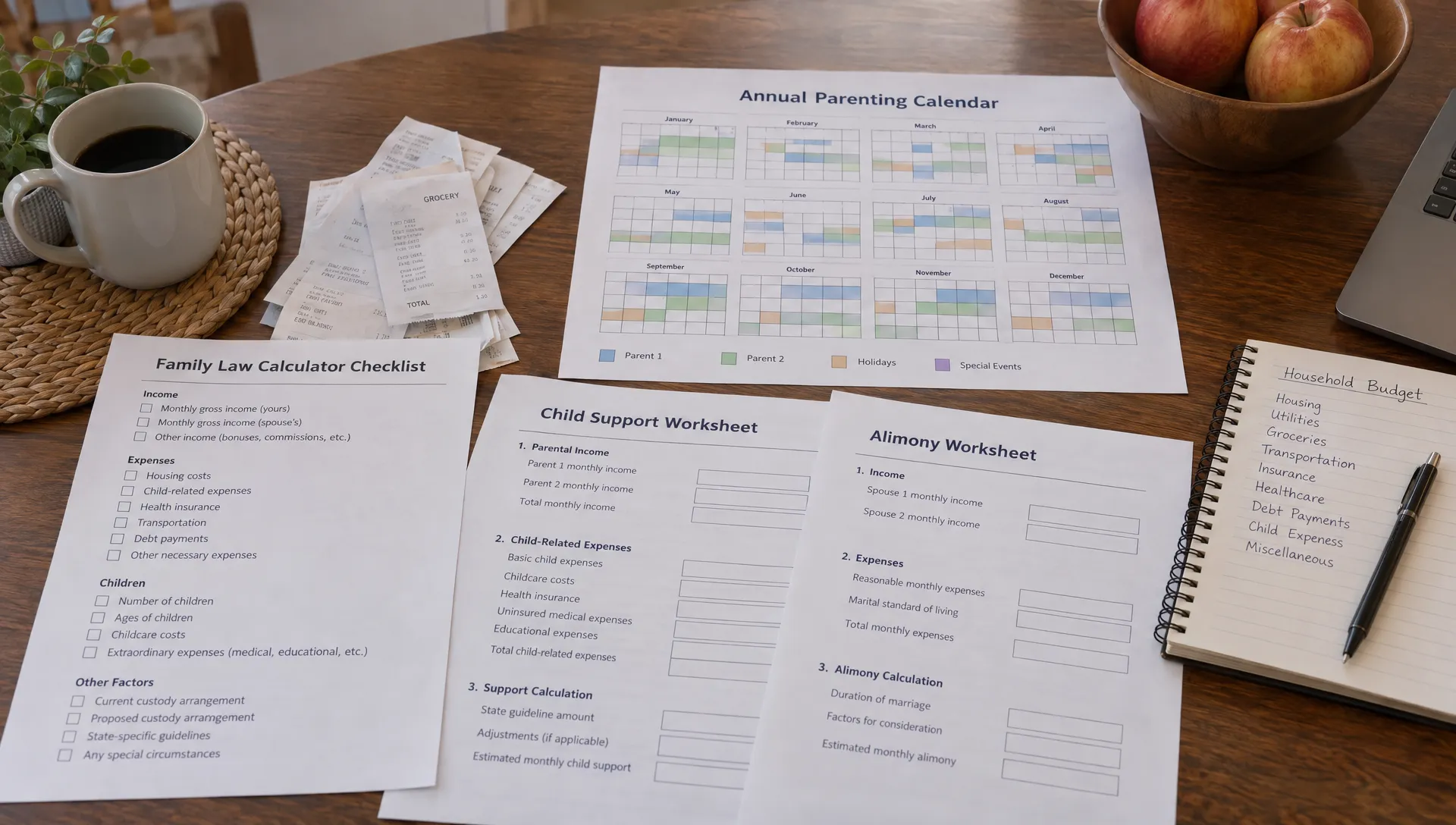
Have a proposed annual parenting calendar available, including holidays and school breaks. Check whether the calculator requests overnights, hours or a percentage. Use its required unit consistently.
If you need to establish the schedule first, this guide to counting overnights for a custody percentage explains how to avoid double-counting holidays and vacations.
Also collect documentation for health insurance attributable to the children and eligible childcare expenses. A family law calculator should explain whether these costs are included in the basic calculation, allocated separately or outside its scope. Entering the entire family insurance premium when only the children’s portion is requested can distort the estimate.
Test a family law calculator before relying on it
Look for an understandable result
Prefer a tool that shows enough detail to review the calculation. Depending on its purpose, that might include the income figures used, parenting-time adjustment, expense allocation and estimated monthly obligation.
A downloadable worksheet can be helpful, but the ability to download a document is not proof of legal accuracy. Check whether it is an official state worksheet or simply the website’s own summary.
If the tool gives only a final number, record the inputs yourself. You should be able to explain what produced the estimate when discussing it with a mediator, attorney or co-parent.
Compare realistic scenarios
Run a baseline using your best-supported information. Then change one uncertain input at a time, such as a proposed parenting schedule or expected childcare expense. Keep other inputs constant so you can see what caused the difference.
For example, compare a current schedule with a proposed schedule while holding income constant. In a separate test, keep the schedule unchanged and enter documented variable compensation. These comparisons reveal which unresolved facts matter most to your budget.
Use the family law calculator to test documented possibilities, not to search for inputs that create your preferred payment. Label each scenario with its assumptions and save the date you ran it.
Finally, place the estimate in a broader monthly budget. Housing, transportation, debt payments and legal costs still matter even when they are not inputs in the support formula. A support estimate alone cannot tell you whether a proposed settlement is affordable.
Review privacy before entering financial details
Calculator inputs can reveal income, family relationships and anticipated custody arrangements. Check the privacy policy before entering sensitive information, especially if the service requires an account or offers to save results.
Look for explanations of what information is collected, whether entries are retained and how account data can be deleted. Check whether requesting a professional review authorizes sharing information with another organization. Basic calculation and a request for legal assistance may involve different data practices.
A family law calculator that asks for Social Security numbers, bank account numbers or full identifying details deserves additional scrutiny. Those details are generally unnecessary for a preliminary estimate. If document uploads are offered, determine whether they are needed and redact unrelated sensitive information where appropriate.
Do not assume that a padlock icon means a site does not store or share data. It indicates a secure connection, not a particular retention policy. Likewise, private browsing does not prevent a website from retaining information you submit.
Recognize when the estimate is not enough
Even a well-designed tool may simplify situations involving unusually high income, disputed earnings, children from other relationships, disability-related needs or complex business ownership. Read its stated exclusions before interpreting the result.
A family law calculator cannot resolve contested facts, determine whether a parent should be assigned earning capacity or predict every discretionary decision. Those issues may require evidence and legal analysis beyond a formula.
Shared parenting also does not automatically eliminate child support. The applicable guidelines may consider income differences and expense allocation alongside parenting time.
If an order already exists, a new estimate does not replace it. Do not reduce payments simply because an online calculation is lower. Modification requirements, effective dates and any restrictions on retroactive changes need separate review through the appropriate process.
Seek individualized help when jurisdiction is unclear, income is disputed or a proposed agreement would depart from the guidelines. An official worksheet can help you organize the numbers, but it does not resolve those legal questions by itself.
Frequently asked questions
Is there a free calculator for divorce-related support? Yes. Free child support estimators and some alimony estimators are available. Choose one that identifies the applicable state rules and clearly describes its limitations. Free access does not establish accuracy, and a paid tool is not necessarily more suitable.
How much child support would I pay if I earn $1,000 per week? Income alone is insufficient. If gross pay is consistently $1,000 each week for 52 weeks, the average is about $4,333.33 per month before deductions. A family law calculator may also need the other parent’s income, number of children, parenting time and eligible expenses, depending on the state.
How do I calculate my parenting-time percentage? Use the counting method required by the relevant guidelines. For an overnight-based estimate, divide your annual overnights by the total overnights in the year and multiply by 100. Account for holidays and vacations without counting the same night twice.
Will the online estimate match the amount ordered? Not necessarily. Differences can arise from simplified formulas, disputed income, missing adjustments or a legally permitted deviation. Treat the result as a planning estimate and compare it with the applicable official worksheet before relying on it in negotiations.
Choose a tool you can explain and verify
The best starting point is a tool that matches your state and legal question, explains its inputs and lets you review the assumptions behind the result.
Child Support Estimate offers free estimates using simplified state guidelines for all 50 states, alongside tools for alimony, parenting time, modifications and arrears. A free attorney review option is also available.
Use a family law calculator to organize your questions and compare budgets. Before signing an agreement or seeking a change to an order, verify the applicable rules and get individualized advice where the facts or law are uncertain.