Choosing a Custody Schedule Calculator for Rotating Work Shifts
Choose a custody schedule calculator for rotating shifts. Compare custom cycles, overnight counts, overtime changes and annual parenting-time totals.
Child Support Estimate ·

Rotating shifts can make a standard every-other-weekend parenting plan difficult to follow. A four-on, four-off rotation moves across weekdays, night shifts require recovery time and mandatory overtime can disrupt an otherwise workable exchange. Choosing a custody schedule calculator means checking whether it can represent those realities, not simply whether it produces a percentage.
The most useful tool lets you compare a complete schedule, inspect how time is counted and identify conflicts before relying on the result. Keep three questions separate: Is the schedule workable for your child, does it follow your parenting order and how does your state measure parenting time for support?
Start with the work rotation, not a standard template
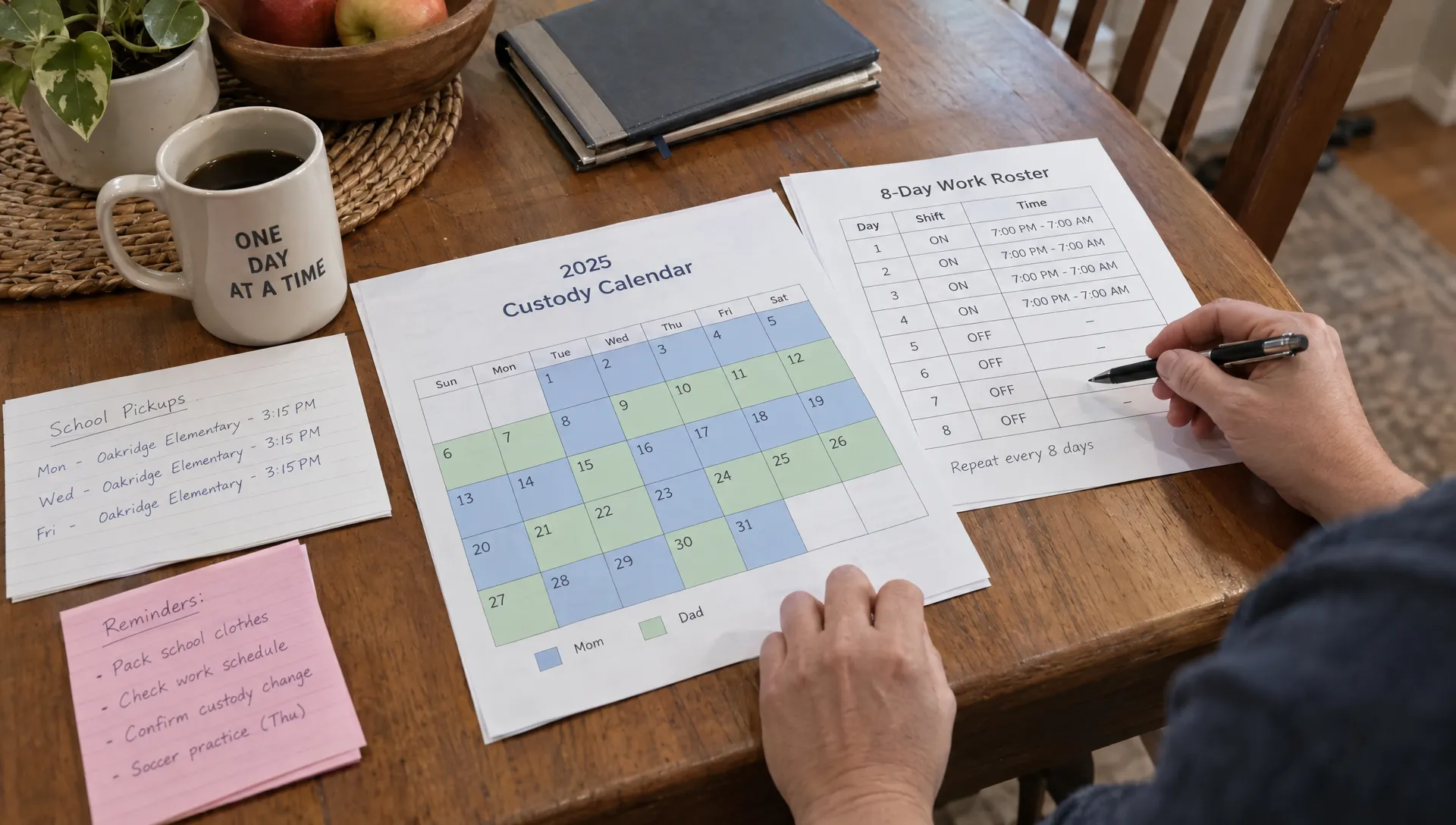
Gather the actual repeating roster, including its start date. “Four days on, four days off” is incomplete without knowing which date begins the cycle and whether those shifts run during the day or overnight.
Record shift start and end times, commuting time, required overtime and realistic sleep periods. A parent finishing a 12-hour overnight shift may technically be off work that morning but still need uninterrupted rest before caring for a young child.
Add the other parent's availability, school or daycare hours and transportation arrangements. Work availability alone does not determine where a child should stay, and using childcare does not automatically eliminate a parent's scheduled time.
Separate fixed commitments from preferences. A mandatory shift belongs in a different category from an optional overtime opportunity. That distinction helps you compare realistic alternatives without rebuilding the entire plan whenever someone volunteers for extra work.
What should a custody schedule calculator handle?
Look for capabilities that match your rotation rather than a long feature list. Use the same sample roster to test each tool.
| Capability to check | Practical test | Why it matters |
|---|---|---|
| Custom repeating cycles | Enter an eight-day or fourteen-day pattern with a specific start date | A weekly template may shift assignments onto the wrong workdays |
| Exact exchange times | Enter a pickup after school and a return the next morning | Hours and overnights can produce different percentages |
| Overnight work | Enter a shift that starts one evening and ends the next morning | Crossing midnight should not create an unexplained gap or duplicate entry |
| Schedule exceptions | Replace regular time with a holiday or approved swap | Exceptions should not be added on top of overlapping assignments |
| Full-year calculation | Extend the pattern through the final date of the year | Partial cycles can change the annual total |
| Reviewable output | Inspect individual dates and save or share the result | Both parents need to understand how totals were produced |
Also check whether separate schedules can be maintained when siblings have different arrangements. One household calendar may hide differences in each child's time.
A custody schedule calculator should make its counting method visible. If the result shows only “50%” without dates, totals or an explanation of the denominator, it is difficult to verify.
Test the annual total with a simple rotating pattern
A short sample can look evenly divided while the full calendar year is not. Consider a hypothetical arrangement giving Parent A four consecutive overnights, followed by four with Parent B.
This is an arithmetic example, not a recommendation that every four-on, four-off worker use that parenting arrangement. Its suitability depends on the child's needs, each parent's availability and any existing order.
Suppose the first four nights of a 365-night planning year belong to Parent A:
| Part of the year | Total nights | Parent A | Parent B |
|---|---|---|---|
| 45 complete eight-night cycles | 360 | 180 | 180 |
| Remaining five nights | 5 | 4 | 1 |
| Annual total | 365 | 184 | 181 |
Parent A's share is 184 ÷ 365 × 100, or approximately 50.4%. Parent B's share is approximately 49.6%.
Use this example to check whether a custody schedule calculator carries the rotation through year-end instead of multiplying an assumed monthly average. A different starting point can change which parent receives the leftover nights.
For an eight-day rotation, reviewing eight weeks also helps reveal how the pattern intersects with weekdays: 56 days contains both seven eight-day cycles and eight calendar weeks. That is useful for spotting recurring school transportation conflicts, but it does not replace the annual calculation.
Define what each time entry means
Hours, overnights and calendar days are not interchangeable. Before comparing percentages, identify which measure you need and what your jurisdiction requires.
For example, California Family Code section 4055 describes a guideline variable based on the approximate percentage of time the higher-earning parent has or will have primary physical responsibility. That is a reason not to assume that a simple overnight percentage is the correct input everywhere.
A custody schedule calculator can organize dates and times, but it cannot establish the legal meaning of those entries for every state.
School hours, exchanges and overnight shifts
Do not automatically exclude school hours, divide them equally or assign them to whichever parent performs pickup. Their treatment can depend on the applicable calculation method and parenting arrangement. Document your assumption and verify it before using the percentage in a support estimate.
For ordinary elapsed-time tracking, use continuous boundaries. If one parent's block ends at Friday at 3 p.m., the next block starts at that same time. Avoid assigning the whole exchange day to both parents.
An overnight shift also requires a clear distinction between the parent's work location and the child's scheduled placement. Record who is caring for the child without assuming that every hour involving a babysitter transfers parenting-time credit to the other parent.
Compare complete annual scenarios
Build at least two workable options, such as a stable school-week arrangement with selected off-duty weekends and a schedule that follows the rotating roster more closely.
Compare the number of exchanges, school-night transitions, transportation demands and recovery periods after night work. A small increase in a parent's percentage may require substantially more disruption for the child.
Apply holidays and vacations to each option before comparing final totals. Usually, an override replaces the overlapping regular assignment rather than creating extra time. This guide to accounting for holiday schedules explains how to avoid double-counting those periods.
Keep the same date range and counting method across scenarios. Otherwise, an apparent improvement may simply reflect different assumptions.
Plan for overtime, shift changes and missed exchanges
A rotation-based schedule needs a process for exceptions. Without one, every overtime request can become a new negotiation.
Discuss how far in advance a parent should share a new roster, how proposed swaps will be communicated and what happens if the other parent cannot accommodate a change. Any arrangement should remain consistent with the controlling order and applicable law.
Keep the agreed schedule separate from the record of what actually happened. For example, an overtime shift may prompt a one-time overnight swap. That does not necessarily mean the recurring pattern should be rewritten.
When testing a custody schedule calculator, check whether a single-date edit changes only that occurrence or every future occurrence. An unnoticed series-wide edit can distort months of parenting time.
Record the original assignment, agreed replacement, actual exchange time and any makeup time. Distinguish a proposal from an accepted change. This explanation of missed visits and makeup parenting time can help you identify issues to clarify in advance.
Keep notes factual. “Exchange occurred at 6:20 p.m.” is more useful for reviewing the calendar than a judgment about why someone was late.
Check sharing, exports and privacy before committing
A usable result needs to be understandable outside the tool. Look for a printable calendar, downloadable file or accessible shared view that the other parent can review without unnecessary barriers.
Confirm whether an export preserves exchange times, holiday overrides and the cycle's starting date. A calendar containing only colored days may lose information that matters to an hourly calculation.
Keep a dated copy of each agreed version. If you share a live calendar, establish who can edit it and how changes will be confirmed. A notification is not necessarily agreement to modify the schedule.
Before entering sensitive information into a custody schedule calculator, review what it collects, who can access shared links and whether records can be deleted. Avoid including children's full birth dates, school addresses or case documents unless they are genuinely necessary and you understand the privacy protections.
Use parenting-time results carefully in support estimates
Once you have a workable calendar and a verified counting method, you can use the appropriate parenting-time figure in a state-specific support estimate. Parenting time is only one input. Income, qualifying childcare expenses, healthcare costs and state-specific adjustments may also affect the result.
Rotating-shift workers should pay particular attention to shift differentials, overtime and irregular earnings. Use the relevant state rules rather than assuming the latest paycheck represents normal income. The guide to estimating support when income varies covers that separate preparation step.
A custody schedule calculator does not determine custody rights, establish an enforceable parenting plan or change an existing support obligation. Likewise, equal parenting time does not automatically mean no support is owed.
Child Support Estimate provides free estimates using simplified state guidelines, with inputs for income, parenting time and expenses. Treat the result as a planning figure, not a court-approved amount.
Recognize issues a calendar cannot resolve
If the proposed rotation conflicts with an existing order, obtain advice from a qualified family-law attorney about the appropriate process before treating the new calendar as controlling. A shared spreadsheet or app entry is not, by itself, a court modification.
Reduced overtime or a shift reassignment may also create separate housing or debt concerns. For a lease, foreclosure or consumer-debt issue affecting household stability, Clair Gjertsen Weathers PLLC describes services in those areas for clients in New York and Connecticut. Those concerns call for different advice from questions about custody or child support.
Frequently asked questions
Can a custody schedule calculator handle a four-on, four-off roster? Some tools support custom repeating cycles, while others offer only weekly templates. Test an eight-day pattern with a specific start date, then inspect several months and the year-end total before relying on it.
Should I count hours or overnights? Use the measure required for your purpose and jurisdiction. An overnight total can describe the calendar, but it may not match the parenting-time measure used in your state's support calculation.
Does time at school count as parenting time? Do not assume it is excluded or split equally. Check the applicable state rules, order and calculation instructions, then use one documented method consistently.
Can parents change the schedule whenever a work roster changes? Parents may be able to agree on certain adjustments, but the effect of that agreement depends on the order and applicable law. Distinguish occasional swaps from a lasting change that may require formal action.
Will a 50/50 schedule eliminate child support? Not necessarily. Differences in income, qualifying expenses and state rules can still produce a support obligation even when parenting time is equal.
Take a verified schedule into your estimate
Choose a tool only after it passes a real-roster test: correct cycle dates, clear counting rules, workable exchanges and a reviewable annual total. Then use that verified information with Child Support Estimate's state-specific tools to explore a support estimate. Keep the calendar assumptions and financial inputs together so you can explain, review and update the result.