Using a Parenting Schedule Calculator for School-Year Planning
Use a parenting schedule calculator to plan school nights, handle breaks and compare overnights with hours before estimating child support.
Child Support Estimate ·

A parenting schedule calculator can help you turn a school calendar into a workable plan for two households. But the result depends on what you count: overnights, hours or another measure required by your state. School dismissal times, teacher workdays and summer arrangements can all change the totals. Start with your child’s daily routine, then use the numbers to check the schedule rather than letting a percentage dictate it.
Define the planning period before counting time
Gather the school district’s published calendar, your current parenting plan or court order and both parents’ recurring availability. Include early-release days, school breaks, transportation responsibilities and before-school or after-school care.
Choose an exact start and end date. A September-through-August planning year captures both the school term and summer, while a September-through-June calculation describes only part of the year. Label the result accordingly, especially if you later use it for a child support estimate.
For example, September 1, 2026, through August 31, 2027, includes 365 calendar dates. A planning year that includes February 29, 2028, has 366. Repeating a weekly pattern 52 times accounts for only 364 days, so the remaining date or dates still need an assignment.
Use the full selected period as your denominator, not just the days school is in session. Your state’s support worksheet may require a different reporting period from your household planning calendar.
Set up your parenting schedule calculator around the right unit
Choose your counting method before entering exchanges. An overnight percentage and an hourly percentage describe different things, even when both come from the same calendar.
| Method | What you count | School-year issue to resolve |
|---|---|---|
| Overnights | Nights assigned to each parent under the applicable definition | A dinner visit may add involvement without adding an overnight |
| Hours | Time intervals between specified exchanges, subject to applicable allocation rules | Dismissal, school arrival and childcare times affect the total |
| Defined days | Days or partial days counted under a particular rule | A calendar date is not necessarily a qualifying parenting day |
For a household planning exercise, document your convention. For a legal or child support calculation, use the method required by the applicable state guideline, worksheet or order. A tool’s default setting does not establish the legal rule.
School attendance also needs explicit treatment. Do not assume school hours automatically belong to whichever parent handled morning drop-off or afternoon pickup. Follow any allocation instructions in the relevant worksheet.
If the underlying documents are unclear, review what parenting guidelines cover and when they apply before treating a general recommendation as a requirement. Keep physical parenting time separate from decision-making authority; a time percentage alone does not describe every aspect of custody.
Build the recurring schedule around school-night needs
Before entering a repeating rotation into a parenting schedule calculator, test whether the exchanges work on an ordinary school week. A schedule that looks balanced numerically may still create rushed mornings, forgotten medication or excessive travel.
Write down actual exchange times rather than labels such as “Wednesday visit” or “every other weekend.” Wednesday from dismissal until 7 p.m. is different from Wednesday dismissal through Thursday school arrival. Likewise, a weekend ending Sunday evening differs from one ending Monday morning.
Check these practical details before comparing percentages:
- Morning travel: Can the child reach school on time from each household without an unreasonable wake-up time?
- Homework and supplies: Where will assignments, devices, uniforms and medication be available?
- Activities and care: Who handles practice, tutoring and childcare when work runs late?
- Exchange logistics: What happens when school is closed and a school-based handoff is unavailable?
For younger children, consider bedtime consistency and the burden of transitions. For older students, include extracurricular commitments and appropriate input from the child without asking them to choose between parents.
Draft a baseline schedule first, then a realistic alternative if needed. Comparing two workable options is more useful than testing many rotations that neither household can sustain. Keep the focus on attendance, rest and dependable care rather than reaching a preferred percentage.
Compare overnights and hours with a two-week example
A parenting schedule calculator may produce different percentages depending on the selected method. Consider this illustrative two-week school-term rotation, during a period without a daylight-saving clock change:
| Parenting interval | Occurrences | Overnights | Hours |
|---|---|---|---|
| Wednesday at 3 p.m. through Thursday at 8 a.m. | 2 | 2 | 34 |
| Friday at 3 p.m. through Monday at 8 a.m. | 1 | 3 | 65 |
| Total for this parent | 3 intervals | 5 | 99 |
The overnight calculation is 5 ÷ 14 × 100 = approximately 35.7%.
The hourly calculation is 99 ÷ 336 × 100 = approximately 29.5%.
These hourly totals use continuous exchange-to-exchange intervals. They are not a statement about how any particular state allocates school hours for support purposes.
The difference is not an error. Five overnight stays can represent less than five complete 24-hour periods because the child arrives in the afternoon and leaves the next morning.
Now consider moving the weekend exchange from Monday at 8 a.m. to Sunday at 6 p.m. That change removes one overnight and 14 hours from the parent’s two-week total. It may also change transportation and homework responsibilities.
Use this comparison to understand the schedule, not to select whichever method gives a preferred result. Neither percentage is an annual figure yet. Holidays, summer arrangements and the leftover dates outside complete two-week cycles still need to be entered.
Replace school-break dates instead of adding them twice
Once the recurring pattern is entered, use the parenting schedule calculator to account for exceptions across the full planning period. Follow the priority rules written into your parenting plan or court order. Do not assume every family’s holiday schedule overrides regular time in the same way.
Suppose one parent’s spring break allocation includes a weekend already assigned to that parent. Those nights appear once in the annual total, not once as regular parenting time and again as vacation time. When the break replaces the other parent’s scheduled nights, reassign those dates rather than adding extra dates to the year.
The same approach applies to summer blocks, winter break and school-specific closures. Our guide to accounting for holiday schedules without double-counting explains the overlap issue in more detail.
Also specify what an exchange means when school is closed. “At dismissal” does not provide a usable time on a teacher workday. The existing plan may contain a fallback location and time; if it does not, seek clarification through an appropriate agreed or legal process.
Finally, check the annual totals. For a straightforward overnight calendar, each night should be assigned once. If your legal counting method allows different treatment of unusual arrangements, follow that rule and document the exception.
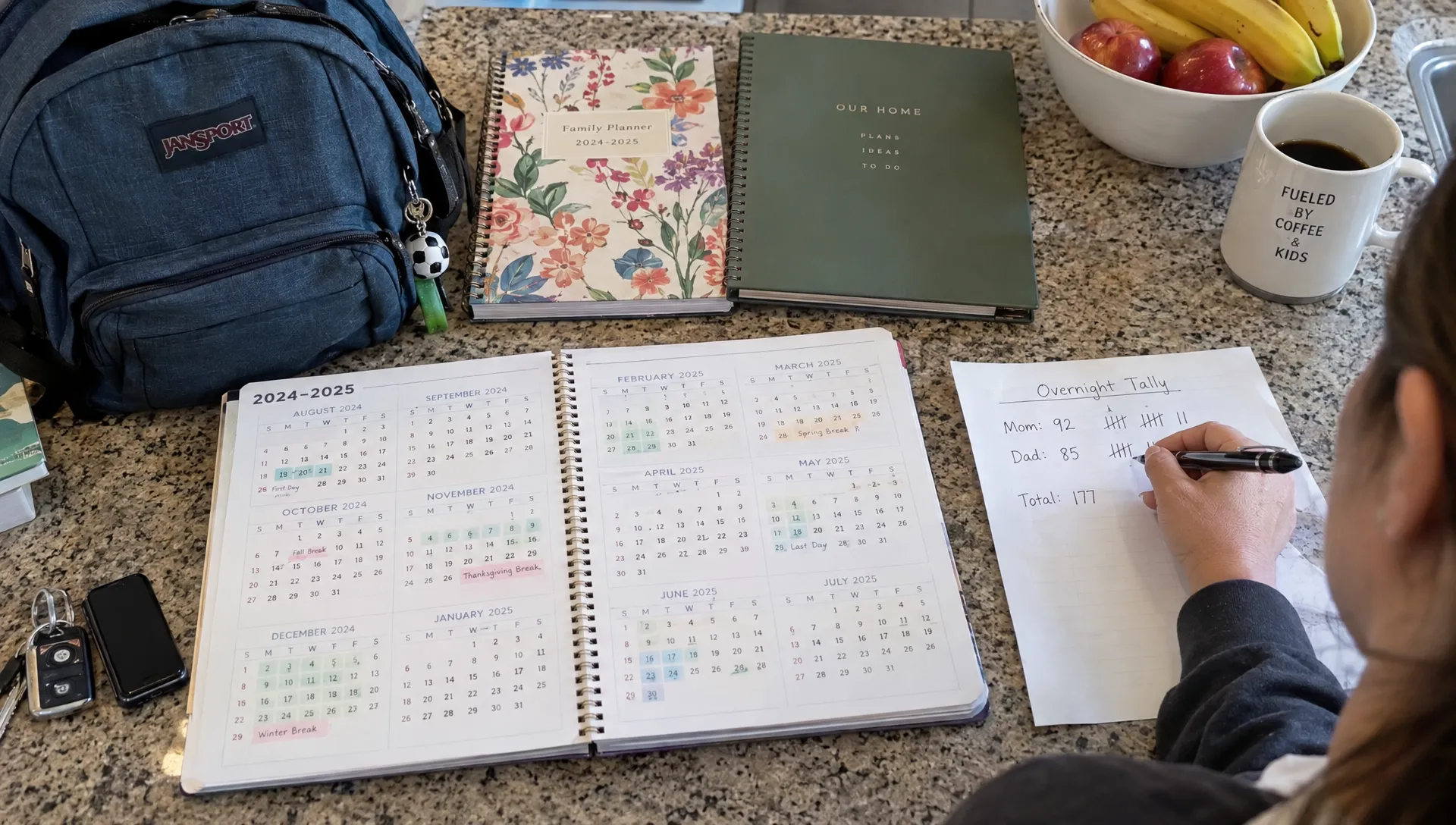
Keep planned and actual parenting time separate
Save the completed calendar as your planned baseline. Then maintain a separate factual record of actual exchanges. This makes it easier to identify whether a schedule needs a logistical adjustment without repeatedly rewriting the original plan.
A simple record can include the date, planned exchange, actual exchange, reason for the difference and whether replacement time was agreed. Describe events neutrally: “School closed; pickup occurred at 4 p.m.” is more useful than assigning blame.
Review patterns at practical checkpoints, such as after the first month of school and before winter break. A single delayed pickup may have little planning significance. Repeated missed school-night visits or a recurring transportation problem may warrant a discussion about what is sustainable.
Track each child separately if siblings attend different schools or follow different schedules. A shared family percentage can conceal differences that matter for transportation, childcare and potentially a support worksheet.
An actual-time log does not, by itself, change a court order or support obligation. Ask a qualified local professional how actual versus ordered time is treated before using the record in a legal calculation.
Keep shared records limited to necessary information. Avoid placing children’s full identifying details, school access information or unrelated financial documents in broadly accessible calendars.
Use the annual total carefully when estimating support
The annual result from a parenting schedule calculator is one possible input into a child support estimate, not a payment determination. Its usefulness depends on whether the counting method matches your state’s requirements.
For example, California Courts’ child support guidance identifies parents’ income and time with the child among the factors affecting support. That does not mean California’s treatment of parenting time applies elsewhere. Other jurisdictions can use different definitions, adjustments or qualifying thresholds.
Before transferring a percentage into a financial tool, confirm whether it requests annual overnights, hours, days or a percentage. Check whether it asks for ordered, expected or actual time. Do not enter 35.7% merely because that was the overnight result if the worksheet requires another measure.
Income, eligible childcare costs and healthcare expenses may also affect the estimate. A school-year change can alter after-school care costs even when the overnight total stays the same.
Equal parenting time does not necessarily produce zero support. Likewise, crossing a parenting-time threshold does not automatically change an existing obligation. If the schedule has materially changed, check your state’s modification process rather than adjusting payments on your own.
Frequently asked questions
Can I use a free parenting schedule calculator for school-year planning? Yes, for estimating time, provided you understand its inputs and counting method. Check whether it supports dated exceptions or only calculates a repeating pattern. A percentage-only tool still needs a separate calendar for breaks and exchanges.
Should school hours count toward parenting time? For support purposes, follow the applicable state rules and worksheet instructions. For personal planning, document your chosen convention. Avoid treating school attendance as automatically assigned to the parent who provides transportation.
Can I use a school-term percentage as my annual percentage? Not without checking the rest of the year. Summer, holidays and other exceptions can change the annual result. Calculate the complete required period before using the number in a support estimate.
What if a snow day changes the exchange? Follow any school-closure or fallback provision in your plan or order. Record what actually happened separately. A closure does not necessarily change the legal allocation of parenting time, and a calculator cannot resolve an ambiguous provision.
Turn your calendar into a planning estimate
Once your parenting schedule calculator totals reflect the complete year, use Child Support Estimate’s free tools to explore parenting time and estimate support under simplified state guidelines. Have both parents’ income information and relevant childcare and healthcare expenses ready.
Treat the result as a budgeting starting point, not legal advice or a replacement for an official worksheet. Keep your dated calendar alongside the estimate so the assumptions remain clear.